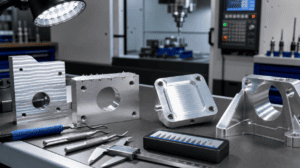
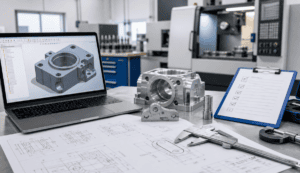
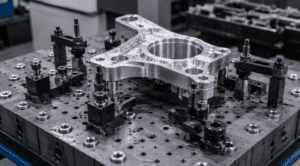
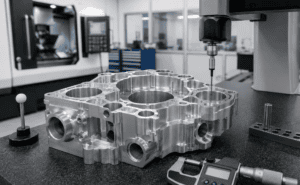
Black oxide coating is a cost-effective surface finish for CNC machined parts that require a black appearance, low reflection, mild corrosion resistance, and tight dimensional accuracy. It is commonly used for steel parts, fasteners, shafts, gears, and precision mechanical components.
In this guide, you will learn how black oxide coating works, which materials are suitable, its main advantages and limitations, and when to use it for CNC machined parts.
What Is Black Oxide Coating?
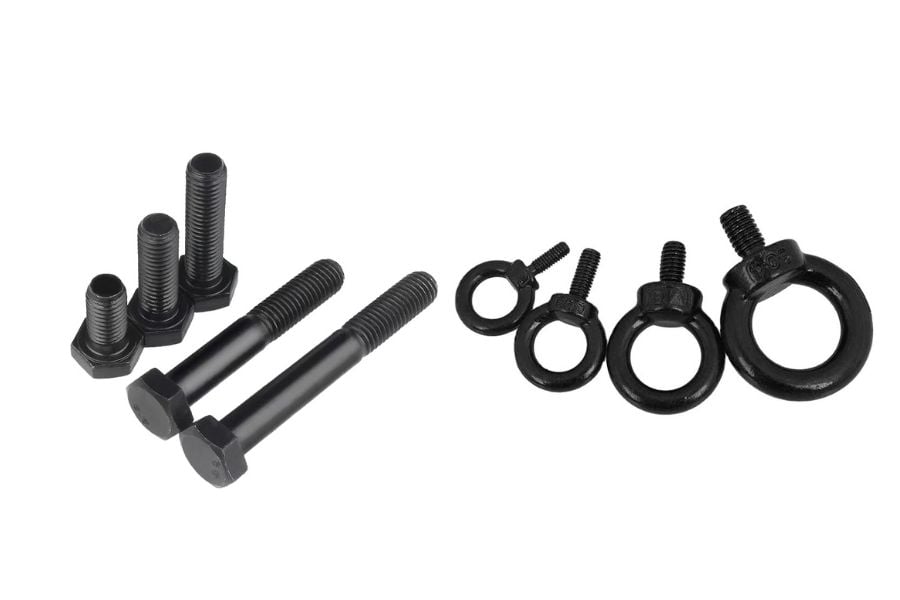
Black oxide coating, also known as blackening or black oxide finish, is a chemical conversion coating. Unlike paint or powder coating, it does not simply cover the surface with a thick external layer. Instead, it reacts with the metal surface and forms a thin black oxide layer.
For steel parts, the black layer is usually magnetite, also known as Fe₃O₄. This layer gives the part a dark black appearance and helps improve mild corrosion resistance, especially when combined with oil, wax, or other sealants.
Black oxide is commonly used on carbon steel, alloy steel, stainless steel, copper, and brass. However, different materials require different processes. For example, traditional black oxide is most commonly used for steel parts, while aluminum parts are usually treated with black anodizing instead of black oxide.
One important advantage of black oxide coating is that it has very little impact on part dimensions. This makes it suitable for precision CNC machined parts with tight tolerances.
How Does the Black Oxide Coating Process Work?
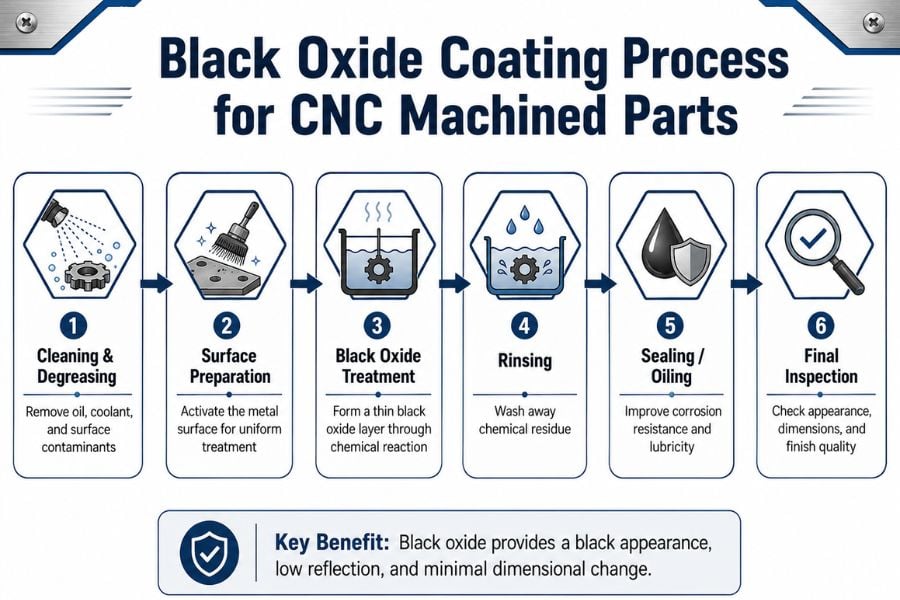
The black oxide process usually includes cleaning, surface preparation, chemical treatment, rinsing, sealing, and final inspection. Each step affects the final appearance and performance of the part.
- Cleaning and Degreasing
Before black oxide treatment, the parts must be cleaned thoroughly. Oil, cutting fluid, dust, fingerprints, rust, or machining residue can affect the chemical reaction. Poor cleaning may cause uneven color, stains, or poor surface quality.
For CNC machined parts, cleaning is especially important because machining oil and coolant can remain on holes, threads, grooves, and complex surfaces.
- Surface Preparation
After cleaning, the parts may need acid cleaning, activation, or other pre-treatment depending on the material and surface condition. The goal is to prepare the metal surface for a stable and uniform black oxide reaction.
If the surface is not properly prepared, the final coating may show color variation, spots, or inconsistent appearance.
- Black Oxide Treatment
The parts are placed into a chemical solution where the black oxide layer forms through a controlled reaction. Different black oxide processes use different temperatures and chemical systems.
Hot black oxide is usually used for high-quality steel parts. Mid-temperature and cold black oxide processes are also available, depending on production needs, cost, and part requirements.
- Rinsing
After chemical treatment, the parts are rinsed to remove chemical residue. Insufficient rinsing can lead to stains, corrosion, or surface contamination after finishing.
- Sealing or Oiling
Black oxide alone provides limited corrosion resistance. To improve protection, the parts are usually treated with oil, wax, or sealant. This step is very important because it improves rust resistance and gives the part a smoother final appearance.
- Final Inspection
After finishing, the parts should be inspected for color consistency, stains, rust, scratches, coating defects, dimensions, and packaging requirements. For precision CNC parts, critical dimensions should be checked again after finishing.
Types of Black Oxide Finish
There are three common types of black oxide finish: hot black oxide, mid-temperature black oxide, and cold black oxide.
Hot Black Oxide
Hot black oxide is the most widely used process for steel components. It is performed at high temperatures and produces a durable, uniform black finish. It is suitable for gears, shafts, fasteners, tooling parts, and other precision steel components.
This process usually provides better durability and appearance than cold black oxide, but it requires stricter process control and professional equipment.
Mid-Temperature Black Oxide
Mid-temperature black oxide is processed at a lower temperature than hot black oxide. It can reduce energy consumption and may be useful for some parts that are more sensitive to high heat.
It can offer good appearance and protection, but its performance depends on the specific process and material.
Cold Black Oxide
Cold black oxide is performed at room temperature. It is often used for touch-up, small batches, repair work, or decorative applications. It is easier and less costly, but it usually has lower durability and weaker wear resistance compared with hot black oxide.
Type | Durability | Best For | Limitation |
Hot Black Oxide | High | Steel CNC parts, gears, shafts, fasteners | Requires strict process control |
Mid-Temperature Black Oxide | Good | Parts sensitive to high temperature | May be less durable than hot process |
Cold Black Oxide | Lower | Touch-up, small batches, decorative parts | Weaker wear and corrosion resistance |
Suitable Materials for Black Oxide Coating
Material selection is one of the most important factors when choosing black oxide coating. Not all metals are suitable for the same black oxide process.
Material | Suitable for Black Oxide? | Notes |
Carbon Steel | Yes | Most common material for black oxide |
Alloy Steel | Yes | Suitable for shafts, gears, fasteners, and tooling parts |
Stainless Steel | Yes, with special process | Requires specific black oxide treatment |
Copper | Possible | Usually uses a copper blackening process |
Brass | Possible | Common for decorative and low-reflective parts |
Aluminum | Not typical | Black anodizing is usually preferred |
Zinc | Limited | Requires careful process evaluation |
For aluminum CNC machined parts, black anodizing is usually a better choice because it is specifically designed for aluminum surfaces and offers better appearance and corrosion resistance.
Benefits of Black Oxide for CNC Machined Parts
Minimal Dimensional Change
Black oxide creates a very thin conversion layer. It does not add a thick coating like powder coating or some plating processes. This makes it suitable for precision CNC machined parts where tight tolerance and accurate assembly are important.
Common examples include shafts, pins, gears, bushings, fixtures, and threaded parts.
Attractive Black Appearance
Black oxide gives metal parts a clean black appearance. Depending on the post-treatment, the finish can be matte, satin, or slightly glossy. This makes it useful for both functional parts and visible product components.
Low Light Reflection
Black oxide reduces surface reflection. This is useful for optical equipment, measuring tools, medical instruments, firearm parts, and other components where glare must be reduced.
Mild Corrosion Resistance
When sealed with oil or wax, black oxide can provide mild to moderate corrosion resistance. It is suitable for many indoor and controlled environments. However, it should not be treated as a heavy-duty anti-corrosion coating.
Cost-Effective Finish
Compared with some plating, coating, or painting processes, black oxide is often more economical. It is suitable for high-volume steel parts where appearance, basic protection, and cost control are important.
Improved Lubricity
Oil-sealed black oxide parts can have improved surface lubricity. This can be helpful for fasteners, sliding components, and mechanical parts that require smoother movement.
Limitations of Black Oxide Coating
Although black oxide has many benefits, it also has limitations.
First, it is not suitable for highly corrosive environments unless additional protection is used. For outdoor use, marine environments, high humidity, or salt spray exposure, zinc plating, nickel plating, powder coating, or other protective finishes may be better options.
Second, black oxide usually offers limited scratch resistance. If the surface is scratched or worn, the protection may decrease.
Third, corrosion resistance depends heavily on sealing. Without oil, wax, or sealant, the black oxide layer may not provide enough rust protection.
Finally, color consistency can be affected by material composition, heat treatment condition, surface preparation, and process control.
Black Oxide vs Other Surface Finishes
When choosing a surface finish for CNC machined parts, it is useful to compare black oxide with other common options.
Surface Finish | Main Advantage | Thickness Impact | Corrosion Resistance | Best Application |
Black Oxide | Black appearance and minimal dimensional change | Very low | Mild to moderate with oil | Steel precision parts |
Zinc Plating | Good corrosion protection | Moderate | Good | Fasteners, brackets, hardware |
Nickel Plating | Wear and corrosion resistance | Moderate | Good to excellent | Precision and decorative parts |
Anodizing | Good for aluminum parts | Low to moderate | Good | Aluminum CNC parts |
Powder Coating | Strong color and surface protection | High | Good | Decorative and outdoor parts |
Phosphate Coating | Good oil retention | Low | Moderate | Automotive and mechanical parts |
Black oxide is a good choice when the part needs a black appearance, low reflection, and minimal dimensional change. If stronger corrosion resistance is required, plating or coating may be more suitable.
Common Applications of Black Oxide CNC Machined Parts
Black oxide coating is widely used in different industries.
In the automotive industry, it is used for gears, shafts, bushings, fasteners, and brackets. These parts often require wear resistance, black appearance, and controlled dimensions.
In aerospace applications, black oxide may be used for screws, fittings, and precision steel components where low reflection and dimensional stability are important.
In medical and optical instruments, black oxide helps reduce glare and improve the visual performance of tools and components.
In industrial machinery, it is commonly used for fixtures, pins, spacers, tooling parts, and other mechanical components.
Black oxide is also common for firearm components, sporting goods, electronic hardware, and consumer product parts that require a durable black metal appearance.
Industry | Common Parts | Why Use Black Oxide? |
Automotive | Shafts, gears, fasteners | Wear resistance and black appearance |
Aerospace | Screws, fittings, precision parts | Low reflection and dimensional stability |
Medical | Surgical tools, instrument parts | Reduced glare |
Machinery | Fixtures, pins, spacers | Cost-effective protection |
Electronics | Housings, brackets | Decorative black finish |
Common Defects and How to Avoid Them
Black oxide quality depends on proper cleaning, process control, material consistency, and sealing.
Uneven color is one common issue. It may be caused by poor cleaning, inconsistent surface preparation, or unstable bath conditions. The solution is to improve cleaning, control process parameters, and inspect the parts before finishing.
Rust after coating may occur if the parts are not properly sealed or dried. Using suitable oil, wax, or anti-rust packaging can reduce this risk.
Stains or spots may come from contaminated rinse water, chemical residue, or poor drying. Clean rinsing and controlled drying are important.
Color difference between batches can happen when material composition or heat treatment conditions are different. For mass production, it is better to confirm samples before starting full production.
Defect | Possible Cause | Solution |
Uneven color | Poor cleaning or unstable process | Improve cleaning and process control |
Rust | Weak sealing or poor packaging | Use oil, wax, and anti-rust packaging |
Spots | Contaminated rinse water | Improve rinsing and drying |
Color variation | Different material batches | Confirm samples before mass production |
Poor appearance | Surface contamination | Strengthen pre-treatment inspection |
Quality Testing for Black Oxide Finish
For CNC machined parts, quality testing is important before shipment.
Visual inspection is used to check color, stains, rust, scratches, and overall appearance. Salt spray testing may be used when corrosion resistance requirements are specified by the customer.
Dimensional inspection is important for tight tolerance parts. Although black oxide has minimal thickness impact, key dimensions should still be checked after finishing.
A rub test or adhesion-related check may be used to see whether the surface is stable and clean. For export orders, packaging inspection is also important. Anti-rust bags, desiccants, oil paper, or vacuum packaging may be needed depending on the shipping time and environment.
Design and Purchasing Tips for Black Oxide CNC Parts
When sourcing CNC machined parts with black oxide coating, buyers should provide complete technical information to the supplier.
First, confirm the base material. Carbon steel, stainless steel, copper, brass, and aluminum may require different finishing processes.
Second, define the desired appearance. For example, the part may need matte black, satin black, or oil-sealed black finish.
Third, identify critical dimensions and tolerances. This helps the supplier protect important assembly features during machining and finishing.
Fourth, explain the working environment. Indoor use, outdoor use, humidity, salt spray, high temperature, oil contact, and chemical exposure can all affect finish selection.
Finally, provide drawings, 3D files, material grade, surface finish requirements, inspection standards, and packaging requirements. For large-volume production, it is recommended to make samples before mass production.
When Should You Choose Black Oxide Coating?
Black oxide is a good choice when your CNC machined parts need a black appearance, low reflection, mild corrosion resistance, minimal dimensional change, and cost-effective finishing.
It is especially suitable for steel precision parts, fasteners, shafts, gears, fixtures, pins, bushings, and tool components.
However, it may not be the best option for marine environments, long-term outdoor use, high-salt conditions, or parts that require strong corrosion protection. In those cases, zinc plating, nickel plating, powder coating, or other finishes may be more appropriate.
For aluminum parts, black anodizing is usually preferred.
Black Oxide Coating Cost Factors
The cost of black oxide coating depends on several factors, including material type, part size, geometry, batch quantity, surface preparation requirements, process type, sealing method, inspection standards, and packaging requirements.
Simple steel parts in large quantities are usually more cost-effective. Complex parts with strict appearance standards, deep holes, threads, high corrosion requirements, or special packaging may increase the total cost.
To receive an accurate quote, buyers should provide drawings, material information, quantity, finish requirements, and application details.
Conclusion
Black oxide coating is a cost-effective surface finish for CNC machined parts that need a black appearance, low reflection, mild corrosion resistance, and minimal dimensional change. It is commonly used for steel parts, fasteners, shafts, gears, fixtures, and precision components.
To achieve a reliable finish, the right material, cleaning process, sealing method, and quality control are essential. For harsh or highly corrosive environments, other protective finishes may be more suitable.
Need CNC machined parts with black oxide coating? Send us your drawings, material, finish requirements, and application details. Our engineering team will help you choose the right machining and finishing solution.
Frequently Asked Questions
Q: Does black oxide coating prevent rust?
A:Black oxide can improve corrosion resistance, especially when sealed with oil or wax. However, it does not provide heavy-duty rust protection like zinc plating, nickel plating, or powder coating.
Q: Does black oxide coating affect part dimensions?
A: Black oxide has very little impact on part dimensions because it forms a thin conversion layer. This makes it suitable for precision CNC machined parts.
Q: Is black oxide better than zinc plating?
A: It depends on the application. Black oxide is better for black appearance and low dimensional change, while zinc plating usually provides stronger corrosion protection.
Q:Can stainless steel be black oxide coated?
A:Yes, stainless steel can be black oxide coated, but it requires a specific process different from standard steel black oxide treatment.
Q: Can aluminum be black oxide coated?
A: Traditional black oxide is not commonly used for aluminum. If a black finish is needed for aluminum CNC parts, black anodizing is usually a better option.