Producing an accurate steel component is not simply a matter of cutting its final geometry. The order of machining, heat treatment, and finishing can determine whether a shaft runs true, a gear meshes quietly, or a hardened mold component meets its drawing. Soft machining is a key stage in that manufacturing sequence: it shapes the workpiece while the material is still comparatively machinable, before its final hardening operation.
The objective is to remove material efficiently without compromising the surfaces and dimensions that must survive heat treatment. Understanding this stage helps engineers specify parts, compare quotations, and reduce scrap.
What Is Soft Machining?
Soft machining is the cutting of a workpiece in a relatively unhardened or lower-hardness condition, typically before final heat treatment. It includes operations such as CNC turning, milling, drilling, boring, and gear cutting. The word “soft” describes the workpiece’s condition relative to its intended hardened state; it does not mean that the process only applies to soft metals such as aluminum or copper.
Consider an alloy-steel gear that must have a hard, wear-resistant tooth surface. A manufacturer can first turn the blank, create locating features, and hob its teeth. The gear is then carburized and hardened; if the design requires exceptional accuracy, the teeth or reference surfaces are ground or honed afterward. In this example, turning and hobbing are soft-machining operations.
Soft machining is a process-planning term, not a specific CNC machine or an industry-wide hardness limit. An annealed tool steel, for example, may be suitable for soft machining even though it is much harder to cut than a free-machining carbon steel. Machinability depends on the alloy, microstructure, and tooling.
How Does the Soft Machining Process Work?
A reliable soft machining process begins with the finished component requirements and works backward through the expected heat-treatment and finishing stages. The following sequence is typical for a heat-treated precision steel component, although the operations vary by design.
1. Review the Drawing and Material Condition
Confirm the steel grade, required final hardness or case depth, geometric tolerances, surface finish, and inspection datums. Establish whether the material arrives annealed, normalized, or pre-hardened. A drawing that says only “steel” is insufficient for a reliable quotation.
2. Prepare the Blank and Establish Datums
Cut the bar, forging, or casting to an appropriate size. Face and turn or mill reference surfaces that can be used consistently in later setups. On gears, the bore and locating faces must support tooth cutting and final finishing.
3. Rough Machine and Semi-Finish
Remove most of the excess stock by turning, milling, drilling, or specialized gear cutting. Semi-finishing develops the intended geometry while leaving a planned finishing allowance on surfaces that will be ground, honed, or hard turned. Consider difficult features before hardening if subsequent treatment will not compromise them.
4. Inspect and Prepare for Heat Treatment
Check critical dimensions, stock distribution, burrs, and datum relationships. Where material, section thickness, and machining history justify it, an engineer may specify intermediate stress relief or another stabilization step. Stress relief is not necessary for every part.
5. Harden, Finish, and Inspect
Apply the specified treatment, such as carburizing and quenching, induction hardening, or quenching and tempering. Assess the resulting hardness and dimensional movement. Then finish only those surfaces that require post-hardening correction. Inspect final dimensions, geometry, roughness, and hardness as required.
Typical process flow: Material verification → Blank preparation → Soft machining → Intermediate inspection → Heat treatment → Hard finishing where required → Final inspection.
Common Soft Machining Methods
CNC Turning
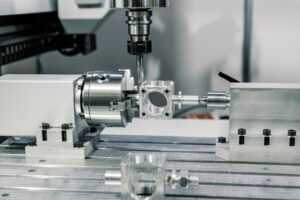
Soft turning is widely used for shafts, bearing seats, bushings, gear blanks, sleeves, and cylindrical housings. It establishes diameters, shoulders, faces, grooves, and preliminary bores. Datum errors can carry concentricity problems into later grinding.
CNC Milling
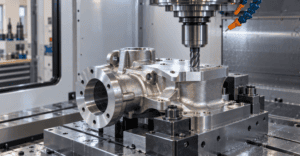
Milling creates faces, pockets, slots, mounting details, and complex prismatic profiles. It is frequently used on mold bases, fixtures, and structural machine components before a hardening cycle. Balanced stock removal and clamping matter for thin parts.
Drilling, Boring, and Threading
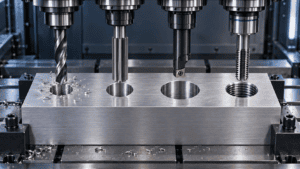
Creating holes and threads before hardening can avoid costly specialty tooling later. However, a bore that must retain very tight circularity or a fine surface finish after heat treatment may need to be left undersize for hard boring or grinding. Allow access for later inspection and finishing.
Gear Hobbing, Shaping, and Power Skiving
For gear manufacturing, soft machining is a particularly established term. Hobbing efficiently generates many external tooth profiles. Shaping can serve internal gears and geometries with limited cutter clearance; power skiving is another option for suitable internal and external gear designs. Selection depends on geometry, volume, and hard-finishing needs.
Which Materials Are Suitable for Soft Machining?
The most relevant materials are steels that will subsequently receive a specified hardening or surface-treatment process. These grades are not interchangeable.
- Carbon steels, such as AISI 1045: used in shafts and machine components; hardening response and final property requirements should be assessed for the part geometry.
- Alloy steels, such as 4140: often machined in an annealed or otherwise defined condition before a selected quench-and-temper or local-hardening operation.
- Case-hardening steels, such as 8620: suitable for gear and transmission components that are machined before carburizing and subsequent finishing.
- Tool steels, such as D2 and H13: can be machined in a suitably annealed condition, with later hardening and precision finishing planned around their distortion risks.
- Hardenable stainless steels: certain martensitic or precipitation-hardening grades can follow staged machining and hardening or aging sequences, but the process varies substantially by grade.
Do not assume that all stainless steels will harden using the same thermal cycle. Austenitic 304 is not conventionally quench-hardened and can work-harden during cutting.
Advantages and Limitations of Soft Machining
Why Manufacturers Use It
- Efficient bulk removal: cutting before hardening generally allows productive roughing strategies and broader tooling choices.
- Lower cutting-tool demands: compared with machining the same alloy at a much higher hardness, forces, edge wear, and tooling costs can be easier to manage.
- More accessible feature creation: holes, grooves, keyways, and tooth forms may be simpler to generate before hardening.
- Better overall process planning: datums and controlled stock allowances can be established before downstream treatment and finishing.
- Flexible production: CNC programs can accommodate prototypes and repeat production, subject to fixture and inspection capability.
What It Cannot Guarantee
Soft machining alone does not ensure final dimensional accuracy. Heating, quenching, phase transformation, and the release of residual stresses can change the workpiece’s size or shape. A surface produced to a fine tolerance before treatment may no longer satisfy that tolerance afterward. Conversely, leaving too much stock increases grinding time, while leaving too little may prevent complete cleanup of distortion or scale. Savings require a coordinated process.
Soft Machining vs. Hard Machining: Key Differences
The distinction is chiefly when the operation takes place relative to hardening and what the operation must accomplish. Hard machining or hard finishing works on already hardened parts, often to achieve final form, size, or surface integrity. Typical methods include grinding, honing, and hard turning.
| Factor | Soft machining | Hard machining |
|---|---|---|
| Material state | Before final hardening or in a lower-hardness condition | After the relevant hardening operation |
| Typical purpose | Remove bulk stock; establish geometry and datums | Finish critical geometry, tolerances, and surfaces |
| Representative methods | Turning, milling, drilling, hobbing, shaping | Grinding, honing, hard turning, selected hard gear cutting |
| Cutting-tool choices | HSS or carbide, depending on operation | Grinding abrasives, CBN, ceramics, or suitable carbide |
| Material removal | Often suited to larger stock-removal volumes | Often suited to smaller finishing allowances |
| Primary risks | Datum errors, uneven stock, later heat-treatment movement | Tool wear, thermal damage, surface-integrity defects |
Which is better? Neither is universally superior. For a hardened bearing journal, soft turning may economically form the shaft while grinding after heat treatment delivers the final running surface. For a part with generous tolerances and no final hardening requirement, post-hardening finishing may be unnecessary. The correct decision follows the performance specification.
Machining Allowance Before Heat Treatment: A Critical Engineering Decision
Finishing allowance is the material intentionally left on a surface after soft machining so a subsequent operation can restore its final size and geometry. It must cover the expected effects of heat treatment, including dimensional change, runout, bow, ovality, and any surface condition that must be removed.
There is no universal safe allowance. The required stock depends on the alloy and heat treatment, part length and section thickness, geometric symmetry, fixture support, achievable pre-treatment accuracy, and the finishing process. Gear teeth, precision bores, and shaft journals may each require different strategies.
How to Determine an Appropriate Allowance
- Identify final-critical surfaces: mark functional datums, fit diameters, sealing surfaces, and gear flanks that need finishing.
- Assess distortion risk: use prior production data, heat treater input, or a first-article trial to estimate likely movement.
- Confirm the finishing method: the available grinding or hard-turning setup determines practical stock-removal and access limits.
- Balance the allowance: leave enough material to clean up distortion, but avoid excessive stock that increases time, heat, and cost.
- Validate on first articles: measure before and after heat treatment and adjust the soft-machining dimensions where needed.
For example, a long alloy-steel shaft with precision bearing seats may require a different allowance and inspection plan from a compact gear blank. If the shaft bends during quenching, enough stock must remain to restore the intended running axis. Copied allowances cannot replace process validation.
Key Factors That Affect Soft Machining Quality
Cutting Parameters and Tool Geometry
Cutting speed, feed, depth of cut, insert geometry, and coolant strategy should reflect the actual grade and condition. Aggressive removal may improve throughput but can generate deflection or an undesirable surface condition. Tool recommendations are starting points; validated shop data should determine production settings.
Workholding and Datum Consistency
Fixture distortion can create errors even when the CNC program is correct. Thin walls, split rings, and long shafts may need tailored support. Keep the datum scheme consistent wherever practical between soft machining, heat treatment inspection, and hard finishing.
Residual Stress and Heat-Treatment Distortion
Forging, rolling, welding, and earlier material removal may leave residual stresses in the workpiece. Nonuniform sections and quenching conditions can introduce additional dimensional change. Manufacturers should consider balanced cutting, suitable stress-relief steps when specified, heat-treatment fixturing, and inspection after treatment. Distortion cannot always be eliminated.
Measurement and Traceability
Pre-treatment measurement should confirm dimensions and finishing stock; post-treatment inspection should verify that sufficient material remains for final cleanup. For demanding components, record heat-treatment lots, hardness results, datum-related measurements, and final inspection evidence. Select inspection methods according to the drawing.
Industrial Applications of Soft Machining
Automotive and power transmission: gear blanks, gear teeth, shafts, splines, and transmission components commonly follow machining, heat treatment, and selective hard finishing. Noise, vibration, load capacity, and wear performance make the process sequence particularly important.
Industrial equipment: gears, couplings, bearing seats, and wear components often benefit from soft cutting for bulk geometry and controlled finishing after hardening.
Mold and die production: annealed tool steels can be milled and drilled before a hardening cycle, followed by grinding or other precision finishing of functional surfaces.
Aerospace and other high-reliability machinery: selected steel components may use staged machining and heat treatment under documented specifications. Material certification and special-process approvals depend on the individual program.
How to Reduce Soft Machining Costs Without Sacrificing Quality
The lowest machining-hour estimate is not necessarily the lowest finished-part cost. A quote should account for material, blank preparation, setups, tools, inspection, heat treatment, possible straightening, hard finishing, and scrap risk.
- Design for stable workholding: accessible datums and reasonable aspect ratios can reduce setup problems and rework.
- Specify critical features clearly: apply tight geometric tolerances only where function requires them, while keeping final heat-treatment properties explicit.
- Sequence operations intelligently: cut difficult features before hardening where practical and reserve expensive hard finishing for the surfaces that need it.
- Control grinding stock: reduce both excess stock-removal cost and the risk of failing to clean up distortion.
- Validate early: prototypes or first-article runs can reveal dimensional movement before larger production quantities are committed.
When comparing CNC machining suppliers, ask whether the quotation includes heat treatment, finish grinding, inspection reports, and any required subcontracted work. Compare equivalent deliverables.
Frequently Asked Questions About Soft Machining
Is soft machining always performed before heat treatment?
It usually refers to machining before final hardening. However, a component may receive an earlier annealing, normalizing, or stress-relief treatment before it is soft machined. The important distinction is its condition during cutting relative to the subsequent hardening stage.
Can soft machining achieve tight tolerances?
Yes, a suitably controlled CNC operation can achieve tight pre-treatment dimensions. But heat treatment may change those dimensions. Final tolerances on hardened functional surfaces sometimes require grinding, honing, or hard turning afterward.
Does soft machining apply to aluminum?
Aluminum can certainly be CNC machined, but routine aluminum machining is not what manufacturers typically mean by soft machining in a steel hardening process chain. The term is more useful when distinguishing a lower-hardness machining stage from later machining of a hardened component.
Is soft machining cheaper than hard machining?
For high-volume stock removal on the same material, pre-hardening machining is often more economical. Final part cost depends on the entire process: heat treatment, distortion control, setup count, inspection, and any hard finishing required.
What should be included in an RFQ for soft-machined parts?
Provide the 2D drawing and 3D model, material grade and supply condition, quantity, required final hardness or case depth, dimensional and GD&T requirements, surface finish, inspection expectations, and delivery requirements. Clarify whether the supplier must provide heat treatment and post-hardening finishing.
Conclusion: Plan Soft Machining Around the Finished Part
Soft machining is not merely an easier way to cut steel. It is the stage where a manufacturer creates geometry, establishes datums, and manages the stock needed for successful hardening and final finishing. The best results come from treating soft machining, heat treatment, inspection, and hard machining as one coordinated manufacturing plan.
Planning a precision CNC project? Share your drawings, material specifications, required hardness, tolerances, and expected quantities with a machining partner. A technical review helps establish the sequence and finishing allowances.