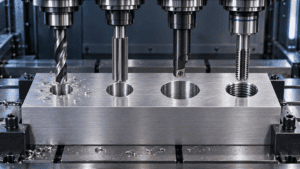
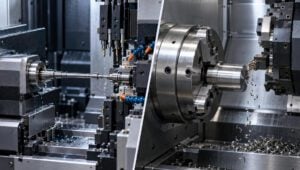
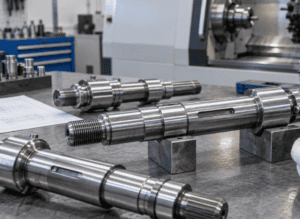
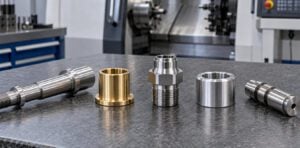
Hole-making is one of the most common operations in CNC machining, but producing a good hole is rarely as simple as “drill and done.” Hole diameter, straightness, roundness, surface finish, thread quality, and positional accuracy all depend on choosing the right process.
For engineers designing CNC machined parts, understanding the difference between drilling, reaming, boring, and tapping helps avoid tolerance problems, high machining costs, and assembly failures.
CNC Drilling
Drilling is usually the first step in hole-making. A rotating drill removes material to create a round hole in the workpiece.
Drilling is suitable for:
- General clearance holes
- Pilot holes before reaming, boring, or tapping
- Through holes and blind holes
- Moderate tolerance requirements
Typical drilling tolerance is not extremely tight. A drilled hole may have slight oversize, taper, burrs, or poor surface finish depending on the material, drill condition, depth, and setup rigidity.
For precision holes, drilling is usually treated as a roughing operation rather than the final operation.
CNC Reaming
Reaming is used to improve the size accuracy and surface finish of an existing drilled hole. A reamer removes only a small amount of material, so the hole must be pre-drilled close to the final size.
Reaming is suitable for:
- Dowel pin holes
- Bearing or bushing fits
- Accurate diameter control
- Better surface finish than drilling
Reaming can achieve tighter tolerances than drilling, but it does not significantly correct hole position. If the drilled hole is off-location, the reamer tends to follow the existing hole.
Good reaming results depend on correct stock allowance, stable fixturing, proper coolant, and suitable cutting speed.
CNC Boring
Boring enlarges and corrects an existing hole using a single-point cutting tool or boring bar. Unlike reaming, boring can improve hole location, straightness, roundness, and diameter accuracy.
Boring is suitable for:
- High-precision holes
- Large-diameter holes
- Holes requiring accurate concentricity
- Critical fits and alignment features
Boring is often used when tolerance, geometry, or positional accuracy is more important than cycle time. It is slower than drilling or reaming but provides better control.
For deep holes or small diameters, boring bar rigidity becomes a major concern. Tool deflection, vibration, and chatter can affect size and surface finish.
CNC Tapping
Tapping creates internal threads inside a drilled hole. Before tapping, the hole must be drilled to the correct tap drill size. If the hole is too small, the tap may break. If it is too large, the thread engagement may be weak.
Tapping is suitable for:
- Internal screw threads
- Blind threaded holes
- Through threaded holes
- Assembly and fastening features
Common CNC tapping methods include rigid tapping, floating tap holders, thread milling, and form tapping. The best method depends on material, thread size, hole depth, production volume, and machine capability.
For blind holes, engineers should allow enough extra depth for the tap point and chip clearance. Bottoming taps can cut closer to the bottom, but they still need space.
Process Comparison
| Process | Main Purpose | Accuracy | Surface Finish | Corrects Hole Position |
|---|---|---|---|---|
| Drilling | Create initial hole | Medium/low | Medium/rough | No |
| Reaming | Improve size and finish | High | Good | No |
| Boring | Improve size, geometry, and position | Very high | Good/excellent | Yes |
| Tapping | Create internal thread | Thread-dependent | Thread-dependent | No |
Design Tips for Engineers
When designing CNC machined holes, consider the function of the hole first. A simple clearance hole does not need the same process as a press-fit dowel hole or precision bearing bore.
Useful design guidelines include:
- Use standard drill sizes when possible.
- Avoid unnecessary tight tolerances on non-critical holes.
- Specify reamed holes for accurate pin or shaft fits.
- Use boring for high-precision diameter, location, or concentricity.
- Provide enough depth for blind tapped holes.
- Avoid very deep small-diameter holes unless functionally necessary.
- Clearly define thread size, depth, and whether the thread is blind or through.
- Add chamfers where parts need easier assembly or burr control.
Conclusion
Drilling, reaming, boring, and tapping each serve a different role in CNC hole-making. Drilling creates the hole, reaming improves diameter and finish, boring provides high accuracy and geometric control, and tapping creates internal threads.
For engineers, the key is to match the machining process to the functional requirement of the hole. This keeps parts accurate, manufacturable, and cost-effective.