Five-axis machining is worth considering when it reaches a feature that a fixed tool direction cannot, removes costly re-clamping, or helps hold a critical relationship between features on different faces. When the features are accessible and a simple fixture can hold the required tolerances, three-axis machining can be the more economical route.
For buyers comparing 3 axis vs 5 axis CNC machining, start with the drawing and ask for the operation sequence. Count how many times the part must be released and located again, identify the dimensions that cross those setups, and compare the cost of the complete batch at your order quantity.
Which machining route fits the part?
| Route | Good fit | What to verify |
|---|---|---|
| Three-axis | Plates, open pockets and parts with accessible features and straightforward workholding | Each required orientation can be located repeatably and inspected to the drawing. |
| Indexed 3+2 | Holes, ports and faces approached from several fixed directions | The holder clears the fixture at each angle and the critical features can be cut while the part stays clamped. |
| Simultaneous five-axis | Surfaces or channels that benefit from changing the tool direction during a cut | Continuous tilting improves access or finish enough to justify programming and verification. |
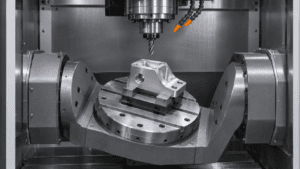
In 3+2 machining, the rotary axes position the workpiece or tool and hold that orientation during the cut. In simultaneous five-axis machining, the machine can change the tool direction as the cut progresses. A part with several angled holes may need only indexed moves. A blade passage may benefit from continuous tilting where a fixed holder angle would interfere. Siemens milling technology manual, section 4.1.
Compare physical setups on the same drawing
Consider a bracket with a top pocket, a bore on one side, an angled mounting face on another side and a finished underside. Assume the stock, tool reach and fixture provide the access described below. The supplier should confirm that sequence against the actual model.
- Three-axis route. Clamp the blank to machine the top pocket, turn it to machine the side bore, locate it on an angled fixture for the mounting face, then flip it for the underside. That is four physical clampings in this example.
- Indexed 3+2 route. Grip the blank at the base, cut the top pocket, then index to the bore and mounting face while the part stays clamped. Flip the part to finish the gripped underside. That is two physical clampings, with multiple tool orientations in the first.
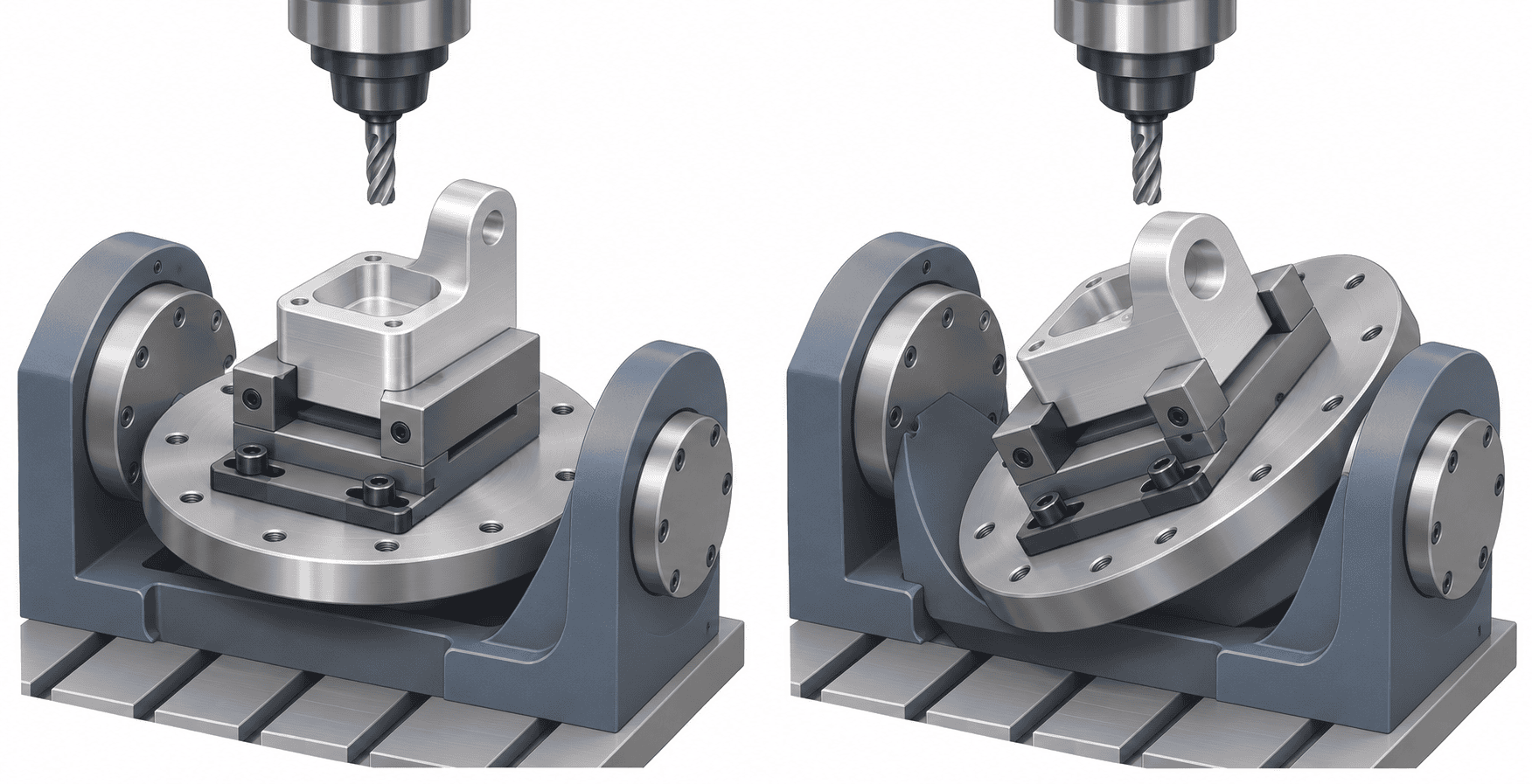
The saving comes from removing two transfers. Each transfer takes time to seat the part, secure it, establish the working origin and check that it is located correctly. At a batch level there may also be fixture changes and first-piece checks. Ask whether a quoted setup count refers to physical clampings per part or to machine changeovers per batch. Those are different costs.
Check what the fixture covers, too. The base may still require a second operation, and a bulky part can lose usable clearance when the table tilts. Have the supplier identify the grip surface, holder clearance and any required prep or finishing operation. If the geometry works on an angle plate with reliable locating surfaces, that three-axis route deserves a quote alongside the indexed option.
Put the critical feature relationships on the setup plan
Imagine that the side bore must be positioned relative to the top mounting features. Cutting both while the bracket stays clamped avoids transferring that relationship through a second locating fixture. It reduces exposure to seating variation, locator repeatability and the way the datum is picked up again. That benefit matters more when the drawing ties the two features together tightly than when each face has generous independent tolerances.
On the same bracket, the underside may be the primary datum in the finished drawing. The supplier still needs a plan to establish or recover that datum across the flip. Ask how the first operation will create references for the next one and how inspection will evaluate the finished part from the drawing datums. A single clamping for the visible faces is useful only if the route controls the final feature relationships.
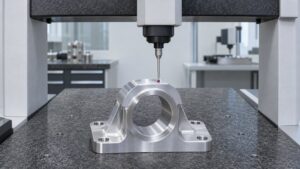
Rotary positioning and alignment also influence where a cut lands after indexing. A shop must manage the machine geometry, fixture rigidity, tool reach and part movement under load. The relevant evidence is a measurement of the features you care about on the part. For a tight side-bore position or a critical surface profile, agree on the inspection method and first-article evidence before comparing routes. Renishaw guidance on checking rotary axis alignment and positioning.
Compare batch cost at the quantities you buy
Ask for one-time charges and recurring costs separately. Programming, proving the first run and dedicated fixtures can raise the cost to start a route. Machine time, part handling and inspection recur as parts are made. Five-axis can win on total cost when the value of fewer transfers and a shorter operation sequence offsets its higher start-up cost or hourly rate.
Here is an illustrative quote comparison for the bracket. Both routes meet the same acceptance requirements. The figures are hypothetical US dollars for the machining and inspection portion of the order. Common material, finish and freight costs are outside this comparison.
| Cost component | Three-axis | Indexed 3+2 |
|---|---|---|
| One-time programming and fixture preparation | $240 | $480 |
| Machine time per part | $38 | $34 |
| Separately billed handling per part | $11 | $4 |
| Inspection per part | $6 | $5 |
| Recurring total per part | $55 | $43 |
| Total for 10 parts | $790 | $910 |
| Total for 20 parts | $1,340 | $1,340 |
| Total for 50 parts | $2,990 | $2,630 |
The machine-time line can fall even when the hourly rate rises. For example, 30 minutes at $76 per hour costs $38, while 20 minutes at $102 per hour costs $34. Those assumed times include cutting and machine movements within the cycle. The separate handling line covers work outside those charged minutes. Ask for that boundary when the two shops format their quotes differently.
The indexed route has $240 more in one-time charges and saves $12 per part. Dividing $240 by $12 gives a break-even quantity of 20 parts for these assumptions. At 10 parts, three-axis saves $120. At 50 parts, indexed 3+2 saves $360. Replace these inputs with your own quotes, and ask whether a fixture or program charge will recur on repeat orders.
Check how the supplier prices time spent loading and probing. If the machine rate already covers that time, a separate handling charge can double-count it. Compare the same inspection scope, finishing, lead time and delivered quantity. If one route requires a second supplier or has a credible higher rework exposure, include that consequence in the decision. Use the quantity you expect to release per order, especially if the program will be run in several small batches.
When simultaneous five-axis earns its place
A curved surface alone can often be machined from a fixed direction. The case for simultaneous motion gets stronger when the cutter must tilt through a passage to keep the holder clear, or when finishing from several fixed angles would leave transitions that matter to the surface requirement. Ask the supplier to identify the exact region where the tool direction must change and to show how it will inspect the result.
Only part of the operation sequence may need continuous motion. A supplier can rough open areas with a fixed orientation, index to reach discrete features and use simultaneous motion for the difficult finishing pass. That mixed sequence can limit the programming and machine time devoted to continuous motion. Check the real reach, fixture, rotary travel and collision clearance for the chosen machine. Siemens guidance on indexed roughing and simultaneous finishing.
What to ask for in a CNC machining quote
Send a STEP model and a matching drawing with material, finish, quantity and revision. Mark the features that mate across faces and the datums that control them. Ask both suppliers to price the same finished part and show the following:
- The faces machined in each physical clamping and how the part is located.
- The feature that drives an indexed or simultaneous move, if applicable.
- How the route holds and measures the critical cross-face dimensions.
- The one-time charges, recurring price per part and assumptions for repeat orders.
- What the quote includes for first-article inspection, finishing and delivery.
When both routes are feasible, request prices at your prototype and production quantities. If tool access or a tight feature relationship makes one route preferable, ask the supplier to identify that feature on the drawing. Share your drawing and batch quantities with Easiahome for a review of the machining route and quote scope. Explore our CNC machining services. Send your drawing for review.
Frequently asked questions
Can five-axis machining finish all six faces in one setup?
It depends on the grip and access. The fixture often covers a surface or holds sacrificial stock that must be removed later. Ask which faces are accessible while clamped and how the remaining surface will be finished.
Is five-axis machining more accurate?
It can improve the relationship between features machined before the part is released. Accuracy still depends on the machine, tool, fixture and inspection method. Compare the actual drawing requirements and the proposed verification plan.
When should I quote three-axis first?
Start there when the part has accessible features, a simple clamping sequence and tolerances the supplier can verify with that route. Ask for an indexed quote as well if repeated transfers or hard-to-hold relationships become a significant cost.