OEM PRODUCT DEVELOPMENT · COOKWARE HANDLES
What Specifications Do You Need for a Custom Pan Handle Quote?
To receive a useful custom pan handle quote, define what is being supplied, how it connects to the cookware and how many units you expect to order. Drawings, material requirements and assembly details help a supplier price the same product you intend to buy.
Define the Scope of Supply First
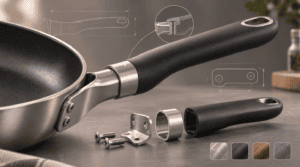
Specify whether you need a complete handle assembly, a grip, a metal bracket or a set of components. A quote for a bare grip is not comparable to one that includes the collar, insert, fasteners and assembly.
- Name each included component.
- State which parts the buyer will supply.
- Identify who performs assembly and final inspection.
- Confirm whether packaging and labeling are included.
For a replacement project, identify the existing product and provide the relevant interface. For a new design, describe what is fixed and which features remain open to supplier proposals.
Provide Drawings and an Assembly Reference
Include a dimensioned drawing and a 3D model where available. A model communicates shape; the drawing should identify dimensions, tolerances, materials and other acceptance requirements.
Provide an assembly view showing how the handle meets the cookware body. Mark critical interfaces instead of applying unnecessarily tight tolerances to every feature. State units explicitly, especially when communicating across inch and metric systems.
Assign a drawing revision and make clear which document controls if files disagree. A supplier should request clarification rather than silently choosing a conflicting dimension.
Specify the Mounting Dimensions
For custom pan handles, the interface is often more important to quotation accuracy than the exterior styling. Missing mounting information can turn an apparently simple price into an estimate based on assumptions.
- Hole diameter, spacing and position.
- Thread size, thread system and required engagement.
- Bracket angle and cookware contact profile.
- Grip bore, insert or internal-rod details.
- Collar dimensions and clearance to the pan wall.
- Fastener and tool-access requirements.
If the cookware wall is curved, supply its profile or a representative sample. Photographs with a ruler can help an initial discussion, but may not define the geometry well enough for tooling approval.
Identify the Material and Finish
For metal parts, state the required grade, stock form if relevant, and finish. For molded grips, identify the exact material or ask the supplier to propose options against your requirements. For wooden handles, specify the wood species, finish and acceptable visual variation.
Separate functional requirements from appearance preferences. A brushed finish, painted surface and molded texture involve different work and approval methods. Include reference samples or approved color references when appearance matters.
If a material is undecided, request separately identified options. Do not compare a firm quote for one material with an unspecified alternative as if both cover the same product.
Give Realistic Order Quantities
State the prototype quantity, first production order and likely repeat-order quantities separately. An annual forecast can help planning, but should not be presented as a guaranteed order unless it is one.
Ask for price breaks at quantities that you could actually purchase. Setup, material purchasing, molds, fixtures and finishing batches can affect the price. Request a separate line for one-time costs rather than hiding them inside a unit price.
If you need a trial batch before a larger order, state that sequence at the start. It affects sampling, tooling and production planning.
Describe Intended Use and Acceptance Requirements
Explain the cookware type, intended heat source, handling conditions, cleaning method and any proposed oven-use requirement. Do not assume a material name establishes these capabilities.
List the inspections and tests required for approval. These may cover critical dimensions, appearance, assembly fit, retention and performance under agreed use conditions. State whether the supplier is expected to propose a test plan or follow a buyer-issued one.
If your project requires compliance documentation for a specific destination or customer, identify the applicable requirement and evidence needed. Avoid a vague request for “all certificates” that does not define the product or requirement.
Clarify Sampling, Tooling and Delivery
Ask whether the sample will use the production process or a prototype method. Separate a shape-and-fit prototype from a production-representative approval sample.
Clarify tooling ownership, maintenance, storage, revision costs and transfer conditions. Request sample and production lead times with the assumptions that start each period, such as drawing approval, deposit or tooling completion.
Provide destination details and ask the supplier to state the delivery terms. For the United States, Australia and Canada, distinguish the manufacturing price from freight and other landed-cost assumptions.
Custom Pan Handle RFQ Checklist
| RFQ field | What to include |
|---|---|
| Scope | Complete assembly, grip, bracket or listed components |
| Files | Drawing revision, 3D model and assembly reference |
| Units and dimensions | Metric or inch units, mounting dimensions and critical tolerances |
| Material | Metal grade, molded material or wood species |
| Finish | Color, texture, coating, polishing or wood treatment |
| Quantity | Samples, initial batch and expected repeats |
| Use conditions | Cookware, heating, cleaning and handling requirements |
| Acceptance | Inspection, sample approval and test requirements |
| Tooling | Charges, ownership and maintenance responsibilities |
| Delivery | Sample target, production target, destination and terms |
| Packaging | Protection, labeling and packing quantities |
Copy This RFQ Email
Subject: RFQ — Custom Pan Handle / Handle Components — [Project Reference]
Hello,
We are sourcing [complete handle assembly / listed components] for [cookware type]. Please review the attached [drawing revision, model and assembly reference].
- Material and finish: [requirements or options to evaluate]
- Mounting interface: [drawing reference and key details]
- Sample quantity: [quantity]
- Initial production quantity: [quantity]
- Expected repeat orders: [forecast, if available]
- Intended use and cleaning: [requirements]
- Inspection and validation: [requirements]
- Delivery destination and timing: [details]
Please quote tooling, samples, unit pricing, included hardware, packaging and delivery terms separately. Identify any assumptions, missing information or proposed manufacturing changes before proceeding.
Thank you.
How to Compare the Quotes You Receive
Check the bill of materials, material grade, finish, quantity basis and inspection scope before comparing prices. Review whether hardware, assembly and packaging are included.
Ask suppliers to resolve differences in writing. A shorter lead time or lower price may depend on a different process, material or scope. The goal is a quote that can become an agreed production specification.
Frequently Asked Questions
Can I request a quote without a technical drawing?
Yes, a supplier may provide an initial review using a sample, photographs and measurements. Any early price should state its assumptions. Agree on a documented specification before tooling or production.
Do I need to provide an annual order forecast?
A forecast helps planning but should be labeled as an estimate. Separate it from the quantity you are ready to order.
Why do suppliers quote different prices for the same photo?
A photo leaves material, internal construction, dimensions, finishing, quantities and inspection open to interpretation. A shared specification makes quotes more comparable.
Prepare Your OEM Project for Review
Use the RFQ checklist to prepare your drawing or sample information, material requirements and order quantities. A clear scope allows a supplier to identify feasibility questions before committing to tooling or production.