Traditional CNC machining is ideal for many precision parts, but complex geometries often require multiple setups, manual repositioning, and secondary operations. Each additional setup increases machining time, cost, and the risk of dimensional error.
5-axis CNC machining solves these problems by allowing the cutting tool or workpiece to move across five axes in one setup. This advanced machining method provides better tool access, higher accuracy, improved surface finish, and greater design freedom for complex components.
In this guide, we will explain what 5-axis CNC machining is, how it works, when to use it, and what industries benefit most from this process.
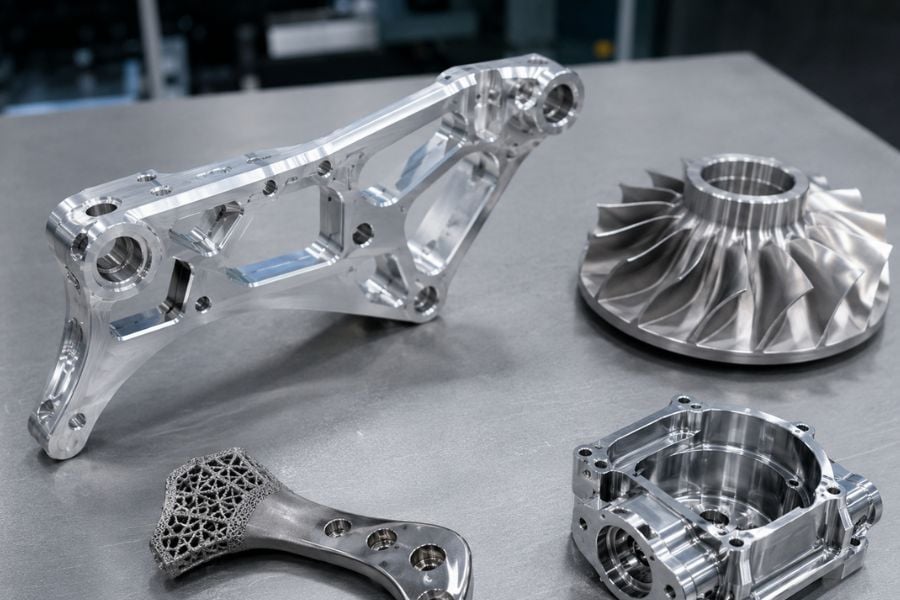
What Is 5-Axis CNC Machining?
5-axis CNC machining is a subtractive manufacturing process that uses computer-controlled cutting tools to remove material from a workpiece. Unlike standard 3-axis machining, which moves along the X, Y, and Z linear axes, 5-axis machining adds two rotational axes.
These additional axes allow the cutting tool or workpiece to tilt and rotate during machining. As a result, the machine can reach multiple sides of a part without repeated manual repositioning.
This makes 5-axis machining especially useful for parts with complex curves, angled features, deep cavities, undercuts, and tight tolerance requirements. It is widely used in aerospace, medical, automotive, robotics, energy, and high-precision industrial applications.
How Does 5-Axis CNC Machining Work?
A 5-axis CNC machine works by combining three linear movements with two rotary movements.
The three linear axes are:
- X-axis: left and right movement
- Y-axis: forward and backward movement
- Z-axis: up and down movement
The two rotational axes allow the tool head, worktable, or workpiece to rotate at different angles. Depending on the machine configuration, these are usually called the A-axis, B-axis, or C-axis.
This movement gives the cutting tool better access to difficult features. Instead of stopping the machine and re-clamping the part, the machine can adjust the cutting angle automatically.
There are two common types of 5-axis machining:
Simultaneous 5-Axis Machining
In simultaneous 5-axis machining, all five axes move at the same time. This is ideal for highly complex surfaces, such as turbine blades, impellers, aerospace structures, and medical implants.
3+2 Axis Machining
In 3+2 machining, the two rotary axes position the part at a fixed angle, and then the machine performs standard 3-axis cutting. This method is often more stable and cost-effective for parts with angled features that do not require continuous 5-axis movement.
Both methods are valuable. The right choice depends on part complexity, tolerance, surface finish, and budget.
5-Axis CNC Machining vs. 3-Axis CNC Machining
Both 3-axis and 5-axis CNC machining can produce accurate parts, but they are suited for different levels of complexity.
Setup Efficiency
3-axis machining often requires several setups for parts with features on multiple sides. Each setup requires manual repositioning, which increases time and potential error.
5-axis machining can complete multiple sides of a part in one setup. This reduces handling, improves repeatability, and shortens lead time.
Geometric Capability
3-axis machines are excellent for simple parts, flat surfaces, pockets, holes, and basic contours.
5-axis machines are better for complex geometries, curved surfaces, angled holes, undercuts, and deep cavities. They give engineers more freedom to design lightweight and high-performance components.
Accuracy
Every time a part is removed and re-clamped, small alignment errors can occur. Since 5-axis machining reduces the number of setups, it helps maintain better feature-to-feature accuracy.
This is especially important for aerospace brackets, medical devices, optical housings, and precision mechanical assemblies.
Surface Finish
5-axis machining allows the cutting tool to maintain a better angle against the workpiece surface. This can reduce tool marks, improve surface finish, and lower the need for secondary finishing.
Key Benefits of 5-Axis CNC Machining
Fewer Setups
The biggest advantage of 5-axis machining is the ability to machine complex parts in fewer setups. This improves efficiency and reduces labor cost.
Higher Precision
Because the part remains fixed for more operations, dimensional accuracy and repeatability are improved.
Better Surface Finish
The tool can approach the workpiece from the best cutting angle, which reduces vibration and improves surface quality.
Shorter Lead Time
Complex components that normally require multiple machining operations can often be completed faster with 5-axis CNC machining.
Greater Design Freedom
Engineers can design parts with more complex shapes, curved surfaces, and angled features without being limited by traditional machining access.
Limitations of 5-Axis CNC Machining
Although 5-axis machining is powerful, it is not always the best choice.
First, machine time is usually more expensive than standard 3-axis machining. For simple parts, 3-axis machining may be more cost-effective.
Second, 5-axis programming is more complex. It requires experienced CAM programmers and skilled machinists to avoid tool collisions and achieve stable results.
Third, not every complex-looking part requires full simultaneous 5-axis machining. In many cases, 3+2 machining or standard CNC milling may be enough.
The best approach is to review the part design, tolerance requirements, material, and production volume before choosing the machining method.
When Should You Choose 5-Axis CNC Machining?
You should consider 5-axis CNC machining when your part has one or more of the following requirements:
Complex Geometry
If the part has curved surfaces, angled features, undercuts, or multiple machined sides, 5-axis machining can simplify production.
Tight Tolerances
For parts that require high positional accuracy between different features, reducing setups can improve precision.
High Surface Finish Requirements
If your part needs a smooth finish on complex contours, 5-axis machining can help maintain better tool contact and reduce visible tool marks.
Difficult-to-Reach Features
Deep cavities, angled holes, and internal features are often easier to machine with 5-axis tool movement.
High-Value Components
For aerospace, medical, optical, and advanced engineering parts, the improved accuracy and reliability of 5-axis machining often justify the higher cost.
Common Applications of 5-Axis CNC Machining
5-axis CNC machining is widely used in industries where precision, performance, and complex geometry are critical.
Aerospace
Aerospace parts often require lightweight structures, complex contours, and tight tolerances. Common applications include aircraft brackets, turbine blades, impellers, engine components, and structural parts.
Medical Devices
Medical components require high accuracy, smooth surfaces, and reliable materials. 5-axis machining is commonly used for orthopedic implants, surgical instruments, dental components, and spinal implants.
Automotive and Motorsports
In automotive and motorsports, 5-axis CNC machining is used for prototype parts, engine components, suspension parts, intake components, and lightweight performance parts.
Robotics and Automation
Robotics parts often need compact structures, precise mounting features, and lightweight designs. 5-axis machining supports these requirements with high flexibility.
Energy and Industrial Equipment
Valve bodies, pump components, impellers, turbine parts, and precision housings can also benefit from 5-axis CNC machining.
Materials Used in 5-Axis CNC Machining
5-axis CNC machining works with a wide range of metals and engineering plastics.
Aluminum
Aluminum is lightweight, easy to machine, and widely used in aerospace, robotics, electronics, and automotive parts. Common grades include 6061, 7075, and 2024.
Stainless Steel
Stainless steel provides strength and corrosion resistance. It is often used for medical devices, industrial parts, marine components, and food processing equipment.
Titanium
Titanium is strong, lightweight, and biocompatible. It is commonly used in aerospace and medical applications, but it requires careful machining control.
Brass and Copper
Brass and copper are suitable for electrical components, connectors, fittings, and precision hardware because of their conductivity and machinability.
Engineering Plastics
PEEK, Delrin, PTFE, Ultem, and nylon are often used for lightweight, insulating, or medical-grade components.
Achievable Tolerances and Surface Finish
The tolerance of 5-axis CNC machined parts depends on material, geometry, machine condition, tooling, and inspection requirements.
For many precision parts, tolerances of ±0.01 mm to ±0.05 mm are achievable. For critical features, tighter tolerances may be possible with proper process control and inspection.
5-axis machining can also produce excellent surface finishes, especially on complex contours. In many cases, the as-machined finish is good enough for functional use. If needed, additional finishing options such as anodizing, bead blasting, polishing, passivation, or coating can be applied.
Design Tips for 5-Axis CNC Machining
Good design can reduce cost and improve quality. Here are several practical DFM tips:
Avoid Unnecessary Complexity
5-axis machining can produce complex parts, but unnecessary complexity increases cost. Use advanced geometry only when it improves function.
Use Proper Internal Radii
Sharp internal corners are difficult to machine. Adding reasonable radii improves tool life, machining speed, and surface finish.
Consider Tool Access
Even with 5-axis capability, the cutting tool still needs enough space to reach each feature. Deep pockets and narrow slots should be reviewed carefully.
Define Critical Tolerances Clearly
Not every surface needs a tight tolerance. Over-specifying tolerances can increase cost without improving performance.
Choose the Right Material
Material affects machining speed, tool wear, surface finish, and total cost. Aluminum is faster to machine, while titanium and stainless steel require more careful control.
Is 5-Axis CNC Machining Right for Your Project?
5-axis CNC machining is an advanced manufacturing process for producing complex, high-precision components. It reduces setups, improves accuracy, enhances surface finish, and gives engineers more design freedom.
However, it is most valuable when the part truly requires complex geometry, tight tolerances, or multi-side machining. For simple components, standard 3-axis CNC machining may still be the better choice.
At EASIAHOME, we provide high-precision 5-axis CNC machining services for aerospace, medical, automotive, robotics, electronics, and industrial applications. Our engineering team can help review your drawings, optimize manufacturability, select the right material, and deliver parts that meet your exact specifications.
Ready to start your next precision machining project?
Contact us today for a fast quote and expert DFM consultation.
Q: Is 5-axis CNC machining suitable for prototype production?
A: Yes. 5-axis CNC machining is excellent for complex prototypes because it reduces setups, improves accuracy, and allows engineers to test difficult geometries before moving to full production.
Q: Does 5-axis CNC machining reduce overall manufacturing cost?
A: For complex parts, yes. Although machine time may cost more, fewer setups, reduced labor, better accuracy, and fewer rejected parts can lower the total project cost.
Q: What file formats are needed for 5-axis CNC machining?
A: Common file formats include STEP, IGES, X_T, and STL. For best results, 3D CAD files should be provided together with 2D drawings showing tolerances and surface requirements.
Q: Can 5-axis CNC machining produce undercuts?
A: Yes. 5-axis machines can access angled and difficult-to-reach features more easily than 3-axis machines, making them suitable for certain undercuts and complex internal geometries.
Q: How long does 5-axis CNC machining take?
A: Lead time depends on part complexity, material, tolerance, finishing, and quantity. Simple prototypes may take a few days, while complex or high-volume projects require longer planning and production.