Choosing stainless steel for a machined component involves more than selecting a familiar grade. A threaded spacer inside a dry machine, a bracket exposed to cleaning water, and a fitting near salt spray face different requirements. Using the same material for all three can increase machining costs or create avoidable corrosion problems.
This guide compares 303 vs 304 vs 316 stainless steel through three purchasing questions: how efficiently can the part be machined, what environment must it survive, and what determines its total cost? For a broader overview of metals and plastics, see our CNC machining materials selection guide.
Quick Comparison: Which Grade Fits Your Part?
Start with service conditions, then compare manufacturing routes. Grade 303 is attractive for extensively machined parts in mild environments. Grade 304 offers a practical balance for many general applications. Grade 316 deserves consideration when improved resistance to chloride-related localized corrosion is required. These are starting points, not automatic approvals for a particular assembly.
| Selection factor | 303 stainless steel | 304 stainless steel | 316 stainless steel |
|---|---|---|---|
| Defining feature | Sulfur addition improves machinability | General-purpose chromium-nickel grade | Molybdenum improves localized corrosion resistance |
| Machining behavior | Usually easiest of these three conventional grades | More demanding chip control and work-hardening management | Requires careful tooling and process planning |
| Environment | Mild, relatively dry service after suitability review | Many indoor and nonaggressive applications | More demanding wet or chloride-bearing exposure, subject to review |
| Welded assemblies | Generally unsuitable as a routine welding choice | Consider 304L where welding requirements justify it | Consider 316L where welding requirements justify it |
| Cost question | Can shorter machining time offset stock cost? | Does it meet the environment without unnecessary alloy cost? | Does added corrosion resistance justify the complete part cost? |
| Candidate parts | Turned spacers, threaded inserts, instrument components | Brackets, equipment components, general fittings | Selected pump, valve and coastal-service components |
The table compares typical selection tendencies. Stock condition, geometry, finish and supplier-specific machining variants can change the result. Confirm the applicable specification rather than treating grades as interchangeable.
How Machinability Changes the Decision
303: Useful when cutting time dominates
Grade 303 is a free-machining austenitic stainless steel. Sulfur-bearing inclusions help chip formation, making it attractive for repeated turning, drilling and threading operations. Atlas Steels’ 303 datasheet identifies machinability as its central advantage.
Consider a small connector with several diameters, grooves and tapped holes. Chip evacuation, tool changes and uninterrupted running can strongly influence unit cost. Where the environment permits 303, the shop may achieve a more economical process. That benefit should be demonstrated in a quotation or trial, rather than assumed from a generic machining percentage.
304 and 316: Process control matters
Conventional 304 and 316 can form difficult chips and work-harden during cutting. Stable workholding, suitable tools and a cutting strategy that avoids rubbing are important. A change in grade can affect cycle time, burr formation and tool consumption even when the drawing stays unchanged.
However, “316 always costs much more to machine than 304” is too broad. Geometry, stock condition and machining-optimized products affect the comparison. Outokumpu’s Prodec range includes machining-optimized grades, showing why the exact purchased material matters alongside its grade designation.
Match Corrosion Resistance to the Real Environment
Why 303 needs a careful exposure review
The sulfur addition that benefits cutting also brings tradeoffs. Free-machining 303 generally has lower pitting resistance than 304 and is a poor default for welded construction. The IMOA fabrication guide explains the relationship between sulfide inclusions, machinability and corrosion performance.
A dry internal component may have very different needs from a part exposed to trapped cleaning solution. Do not replace specified 304 with 303 merely because it machines faster. Obtain engineering approval for any substitution.
When 304 is a sensible baseline
For general equipment, 304 is often worth evaluating first. Ask whether the component encounters condensation, cleaning chemicals, outdoor deposits or liquid-filled crevices. “Indoor use” alone is insufficient: an indoor washdown area can be more demanding than a sheltered, dry outdoor location.
What 316 improves—and where its limits remain
Molybdenum improves resistance to pitting and crevice corrosion relative to 304. Nevertheless, 316 is not corrosion-proof. Temperature, chloride concentration, stagnation and tensile stress still matter. Alleima’s 316/316L datasheet describes both its improved localized corrosion resistance and remaining susceptibility to chloride stress corrosion cracking.
Continuous seawater immersion, warm concentrated chlorides or severe crevices may require another alloy. Review the actual exposure instead of accepting “marine grade” as a complete material specification.
Compare Total Finished-Part Cost
The cheapest bar does not necessarily produce the cheapest accepted component. Compare material purchasing, preparation, cutting time, tooling, finishing, inspection and expected service performance. Request quotations against identical drawings and acceptance requirements.
A practical comparison should separate these cost drivers:
- Stock and availability: grade, diameter, condition, certification and minimum purchase quantity.
- Manufacturing effort: setups, material removal, drilling depth, thread count and tool consumption.
- Acceptance work: deburring, cleaning, surface treatment and dimensional reporting.
- Service consequences: maintenance, replacement access and the effect of corrosion on function.
Grade 316 often carries a higher material cost than 304, but the difference varies with product form and purchasing conditions. Grade 303 may reduce machining expense without being the least expensive stock. Avoid applying one fixed percentage premium to every part.
Quantity also changes the calculation. For a prototype, programming and setup may dominate. On a repeated production order, small cycle-time or tool-life differences can become more significant. Ask for realistic quantity breaks rather than comparing a single sample price with a production quotation.
A useful quotation exercise
Suppose an engineer has approved both 303 and 304 for an internal spacer. Ask the supplier to quote both grades at the same order quantity, with identical threads, tolerances, cleaning and inspection. Request an explanation of any difference: material availability, cutting time, tool consumption or minimum stock purchase. This reveals whether the proposed saving is relevant to the actual component.
Repeat that exercise for 304 and 316 only if both meet the service requirements. A cheaper quotation for an unsuitable material is not a saving. Where corrosion would require dismantling an assembly, the labor and downtime associated with replacement may outweigh the original material premium. Discuss maintenance access and expected exposure before approving the production grade.
Three Practical Selection Examples
The following are illustrative engineering scenarios, not customer case studies or guaranteed material approvals.
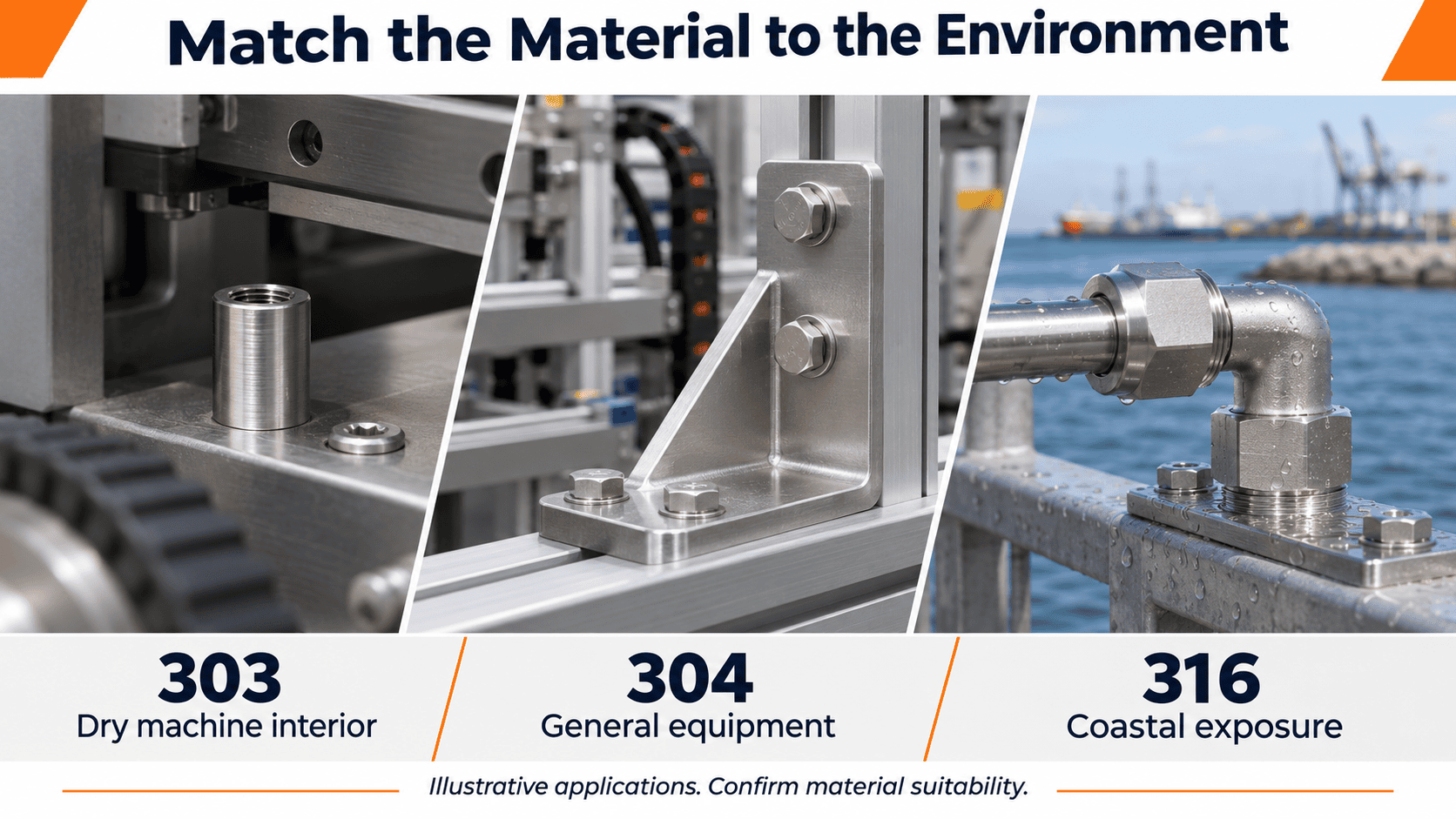
Example 1: A threaded spacer inside a dry machine
The spacer requires turning, a shoulder and an internal thread. It is not welded and does not contact aggressive liquids. Here, 303 is a useful candidate because machining productivity may matter more than additional corrosion resistance. Before approval, confirm mechanical loading, fit, cleaning exposure and any customer restriction on free-machining grades.
Example 2: A bracket for indoor processing equipment
The bracket has milled faces, mounting holes and a welded attachment. Start by evaluating 304 or the appropriate low-carbon variant. Establish the cleaning chemical, concentration and contact time; do not assume that all processing equipment needs 316. If chloride-containing residues remain around fasteners, review both the grade and the joint design.
Example 3: A fitting exposed to coastal spray
The fitting has machined sealing features and sees repeated salt deposition. Compared with 304, 316 is a stronger candidate for the exposure review. Specify surface condition, cleaning access and drainage as well as the grade. If the part is continuously immersed or traps warm salt water, assess whether 316 provides adequate resistance before ordering.
Specify the Material and Manufacturing Route Clearly
A purchase order saying only “stainless steel” leaves too much room for interpretation. Name the grade, relevant product specification, stock condition and required material documentation. Distinguish wrought bar from casting: a casting designation must be assessed under its applicable specification rather than assumed identical to a wrought grade.
For welded parts, state whether 304L or 316L is required. The low-carbon designation addresses particular fabrication concerns; it does not make 304L equivalent to 316L in chloride resistance.
Also identify critical diameters, datum relationships, thread details, surface roughness and inspection requirements. State whether dimensions apply before or after finishing. Keep tight tolerances tied to function; changing from 304 to 316 does not automatically improve dimensional accuracy.
If passivation is required, agree on the process and verification requirements. Free-machining grades need particular attention to cleaning and treatment selection, as explained by Carpenter Technology’s passivation guidance. Passivation does not upgrade 303 into 316 or compensate for an unsuitable alloy choice.
Frequently Asked Questions
Is 303 stronger than 304 or 316?
There is no reliable ranking from the grade number alone. Product form, cold working, heat-treatment condition and section size affect properties. Use the specified condition and certified values for load calculations.
Can 303 replace 304 to reduce machining cost?
Only after the responsible engineer approves the environmental, mechanical and fabrication requirements. A lower cutting cost is not sufficient justification for substitution.
Does every food-related component require 316?
No. Selection depends on contact conditions, cleaning chemistry, hygienic design and applicable requirements. Neither 304 nor 316 is automatically approved for every food-contact application.
Should the prototype and production grades match?
They should match when the prototype is intended to validate material-dependent behavior. A 303 sample can help check assembly geometry, but it does not establish the corrosion performance or machining economics of a later 316 production batch. Record what each trial actually verifies.
Choose Around the Component
For 303 vs 304 vs 316 stainless steel, start with the environment and fabrication requirements, then compare machining and finished-part costs. Share your drawing, material requirement, quantities, exposure conditions and inspection needs with Easiahome for a project-specific manufacturing review.