OEM SOURCING GUIDE · COOKWARE COMPONENTS
How to Choose a Cookware Handle Manufacturer for Your OEM Project
A practical guide to materials, mounting design, samples and production control—for buyers sourcing complete handles or precision metal components.
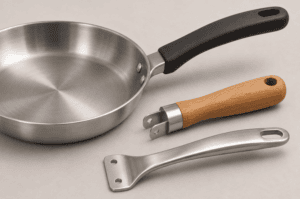
Choosing a cookware handle manufacturer starts with a practical question: can the supplier produce a handle that fits your cookware, meets your performance requirements and stays consistent across production batches?
A handle may look simple, but its performance depends on more than the grip. The mounting bracket, fasteners, material, surface finish and connection to the cookware body all need to work together.
For an OEM project, the right supplier should be able to review this complete assembly, explain manufacturing limitations and provide evidence that production parts match the approved design. This guide covers custom pan handles, wooden grips, molded handles and metal components.
1. Define What You Need the Manufacturer to Supply
Before requesting quotations, decide whether you need a complete cookware handle or individual components.
- A molded, wooden or metal grip.
- A mounting bracket or connector.
- A metal collar or flame guard.
- Threaded inserts, screws, rivets or an internal rod.
- A hanging loop or end cap.
A component supplier may manufacture only the bracket, insert or mounting plate. Both arrangements can work. What matters is knowing who is responsible for material selection, compatibility, assembly and final inspection.
Ask: Which parts do you manufacture in-house, which are sourced externally, and who checks the finished assembly?
2. Match the Material to the Intended Use
Consider the heat source, handling conditions, cleaning method, cookware weight and whether oven use is intended. Appearance alone is not enough to select a material.
Molded cookware handles
Bakelite and other molded materials are options for grips, but a black handle should not automatically be identified as Bakelite. Request the exact material designation and supporting documentation. Confirm whether inserts, collars and mounting components are included.
Temperature and cleaning claims should relate to the specified material and finished assembly. “Heat-resistant plastic” is not a complete performance requirement.
Wooden cookware handles
Specify the wood species, dimensions, finish and appearance requirements. Discuss variation in the mounting area and how the wood connects to the metal components. Agree on acceptable color, grain and surface differences before production. Establish cleaning instructions for the finished product.
Stainless steel and other metal handles
Define the material grade, construction method and finish. Solid, hollow and formed handles can differ in weight, cost and thermal behavior. Stainless steel alone does not establish that a handle stays comfortable to touch or that the complete assembly is suitable for a particular oven temperature. Evaluate these claims under the intended conditions.
3. Check the Mounting Interface Before Approving the Shape
Provide drawings or samples showing the connection area. Check the interface as carefully as the grip.
- Hole spacing, hole diameter and thread engagement.
- Bracket angle and mounting position.
- The surface that contacts the cookware body.
- Clearance for fasteners and assembly tools.
- Grip position relative to the rim and cooking surface.
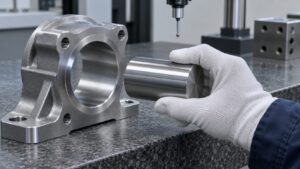
A bracket may have the correct hole spacing but a contact surface that does not match the pan wall. Tightening can leave gaps or place unwanted stress on the assembly. Approve fit on a representative cookware body.
A screw-mounted handle removable for repair is different from a quick-release system designed for frequent removal during use.
4. Choose a Manufacturer With the Right Production Process
Ask why the proposed process suits your geometry and order volume. Identify the dimensions that control fit and function before choosing a manufacturing route.
- Stamping and forming: discuss tooling, material thickness, repeatability and edge finishing for brackets and mounting plates.
- Casting: discuss tooling, surface condition, dimensions and secondary machining for shaped metal parts.
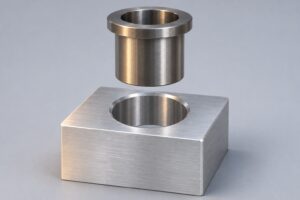
- CNC machining: discuss critical dimensions, tool access and production cost for connectors, inserts and prototypes.
- Welding and assembly: review joints, fixtures, distortion control and inspection.
- Wood machining: define the wood, mounting dimensions, finish and appearance variation.
- Molding: clarify material specifications, inserts, tooling ownership and repeatability.
A more precise process is not automatically the most economical choice for every surface. Keep important interfaces under control without paying for unnecessary machining.
5. Evaluate Samples as an Assembly
Ask how the sample was produced. A machined prototype can confirm shape and fit, but may not represent a later molded, cast or stamped production part.
- Fit, alignment and clearance on the intended cookware body.
- Grip comfort and balance.
- Surface finish and edge condition.
- Fastener installation and resistance to loosening.
- Performance under agreed loading, heating and cleaning conditions.
For detachable handles, include locking, release operation and wear over repeated use. Agree on test methods and acceptance criteria. A claim such as “tested for heavy loads” is incomplete without the setup, conditions and result.
Keep an approved sample with its drawing revision and inspection requirements. Use all three when accepting production.
6. Ask How Production Consistency Is Controlled
The goal is repeatable parts across orders, not simply one acceptable sample. Ask how the supplier controls:
- Incoming materials and purchased components.
- Mounting dimensions, threads, holes and locating features.
- Surface finish and appearance.
- Assembly sequence and fastener installation.
- Batch identification and inspection records.
- Changes to materials, tooling or subcontractors.
Request records relevant to your component and drawing, such as a dimensional report, material record or assembly inspection sheet. Check the scope of any certificates; they do not replace product inspection.
7. Compare Quotations on the Same Basis
Use the same specification when comparing suppliers. Each quotation should identify the included components, materials, finish, sample and tooling charges, MOQ, quantity pricing, inspection, packaging, production lead time and delivery terms.
Clarify tooling ownership, maintenance, storage and transfer conditions. For shipments to the United States, Australia or Canada, separate manufacturing prices from freight, customs and other landed-cost assumptions.
Compare the cost of an acceptable, delivered assembly—not just a grip without its required hardware.
8. Look for Clear Engineering Communication
A capable OEM supplier should ask questions before making firm promises. Useful feedback identifies difficult features, unclear tolerances, interfaces that need checking, alternative processes and tests needed to support performance claims.
Confirm changes in writing. After a revision, both parties should know which drawing and approved sample apply to the next production batch.
What to Include in Your Cookware Handle RFQ
A detailed request helps suppliers assess your project and reduces avoidable clarification.
| RFQ item | Information to provide |
|---|---|
| Product scope | Complete handle assembly or individual components |
| Application | Frying pan, saucepan, wok, stockpot or other cookware |
| Technical reference | Drawings, 3D files, samples or interface measurements |
| Material | Required grade or options to evaluate |
| Mounting details | Hole spacing, threads, brackets, fasteners and contact area |
| Finish | Color, texture, polishing, coating or wood finish |
| Quantity | Initial order and expected repeat-order volume |
| Intended use | Heating, cleaning, handling and storage conditions |
| Validation | Inspection, testing and acceptance criteria |
| Delivery | Sample deadline, production timing and destination |
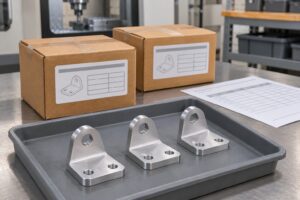
| Packaging | Protection and labeling requirements |
If you do not have a complete drawing, provide a sample or clear photographs with measured dimensions. Ask what additional information is needed before tooling or production.
Questions to Ask Before Selecting a Supplier
- Does the supplier understand whether it is providing a complete handle or components?
- Are material and mounting requirements documented?
- Has the sample been checked on the intended cookware body?
- Does the sample represent the proposed production process?
- Are performance requirements and acceptance criteria agreed?
- Does the quote include hardware, finishing and inspection?
- Are tooling ownership and design changes documented?
- Can the supplier explain how repeat orders remain consistent?
Unanswered questions identify what needs to be resolved before committing to production.
Frequently Asked Questions
Can one cookware handle fit different pans?
Only when the interfaces and intended conditions are compatible. Similar appearance does not prove interchangeability. Check mounting geometry, fasteners, the cookware body and assembly performance.
Is a drawing necessary for a custom cookware handle?
A drawing defines dimensions and acceptance requirements. A sample can start development, but document the agreed specification before production.
Should I buy a complete handle or source components separately?
A complete assembly can simplify coordination. Separate sourcing may suit buyers with their own assembly and quality-control capability. Decide who manages compatibility and takes responsibility for the finished assembly.
What determines the minimum order quantity?
MOQ can depend on tooling, material purchasing, setup, finishing and assembly. Ask for quotes at quantities that reflect expected demand.
Discuss Your OEM Cookware Handle Project
Evaluate the material, connection design, process and production controls together. Start with a clear specification, compare quotes on the same basis and approve the handle on the cookware it will be used with.
Prepare your drawing or sample details, material requirements and estimated order quantity for a manufacturing review.
Use our custom pan handle quote checklist to prepare your specifications, then contact Easiahome about your OEM cookware handle project.