A plastic bushing can pass inspection in a dry workshop and develop a different running fit after installation in humid equipment. A guide block may hold its position indoors but move enough after washdown to affect alignment. These are material-selection problems as much as machining problems.
For POM vs nylon, begin with the environment in which the finished component must work. POM, also called acetal, often deserves the first evaluation when moisture-related dimensional change is a major concern. Nylon can be a strong candidate for loaded wear components, provided its grade, moisture condition and clearances suit the application.
This guide focuses on precision-part selection. For cutting methods and process details, see our POM CNC machining guide; for other material options, consult our CNC machining materials overview.
POM vs Nylon: A Practical Comparison
The table describes general selection tendencies for conventional engineering grades. It does not replace the datasheet for the exact stock being purchased.
| Selection factor | POM / acetal | Nylon / polyamide |
|---|---|---|
| Moisture uptake | Generally low; useful for close-fit components | Often higher in PA6 and PA66; grade and exposure matter |
| Dimensional control | Often a practical starting point for humidity-sensitive fits | Requires careful consideration of moisture condition and dimensional allowance |
| Wear applications | Candidate for guides, small gears and sliding components | Candidate for rollers, bushings and loaded wear parts |
| Load evaluation | Check stiffness, creep and contact conditions for the exact grade | Check properties in the relevant conditioned state |
| Grade choices | POM-C, POM-H and modified bearing grades | PA6, PA66, PA12, cast grades and modified compounds |
| Main purchasing question | Will the grade maintain the required fit throughout service? | Will moisture, loading and wear change performance beyond acceptable limits? |
Why Moisture Absorption Changes the Decision
Nylon absorbs moisture from its surroundings. The amount and rate depend on the polymer, temperature, humidity, exposure time and component geometry. Water immersion and ordinary indoor humidity are different conditions. A thin wall and the center of a thick section will not necessarily reach the same moisture state at the same time.
Mitsubishi Chemical Group’s nylon overview identifies dimensional and property changes associated with moisture uptake. A dry-stock property value therefore may not represent the component after extended operation. Compare grades using data appropriate to the expected condition.
POM generally absorbs substantially less moisture than common PA6 and PA66 grades. This makes it attractive where humidity changes could disturb a close sliding fit or hole spacing. However, low absorption does not mean zero dimensional movement. Ensinger’s dimensional-stability guidance also identifies temperature and thermal expansion as important considerations and lists PA12 among lower-absorption plastics. “Nylon” is too broad to describe one moisture response.
Read moisture figures on the same basis
A 24-hour immersion result, a saturation result and an equilibrium value at a stated relative humidity answer different questions. Compare matching test methods and conditions before ranking materials. Check whether the mechanical data describe dry or conditioned specimens, and whether the values apply to the proposed machined stock.
Also describe the operating cycle. A continuously wet bushing, an intermittently washed guide and a component stored dry before installation can develop different moisture histories. The useful specification connects the delivery condition to assembly and service, with an acceptance check appropriate to the part. One generic absorption figure cannot define that entire cycle.
Translate Dimensional Change into the Actual Fit
A moisture-absorption percentage normally expresses a change in mass under a stated test method. It is not automatically the percentage increase in diameter or length. Do not multiply a shaft diameter by a water-absorption figure and treat the result as an approved machining allowance.
For illustration only, suppose a design assessment assumes a linear dimensional change of 0.2%. Across a 40 mm feature, that equals 0.08 mm. This would matter for a feature specified at ±0.02 mm. The assumed percentage is not a property claim for POM or nylon; the example shows why small environmental changes can consume a tight tolerance.
For a bushing, assess the installed geometry, housing restraint and shaft temperature together. A freely expanding ring and a press-fitted ring do not present the same boundary conditions. Mitsubishi Chemical Group’s engineering thermoplastics design guide specifically includes moisture allowances in nylon bearing design. Use the relevant design method rather than assuming a universal clearance.
Wear Resistance Depends on the Whole Contact System
Both materials are used in sliding and wear applications. “Nylon is always more wear-resistant” and “POM always has lower friction” are unreliable purchasing rules. Wear depends on the exact grade, mating material, surface finish, lubrication, contaminants, temperature, contact pressure and speed.
The manufacturer’s wear-resistance guidance treats these factors as interacting parts of the application. A published friction coefficient from one test should not be treated as a guaranteed value for a different shaft and duty cycle. Where available, compare test results using similar counterfaces and conditions.
For sliding bearings, pressure multiplied by sliding velocity, commonly called PV, is a useful screening parameter. It is not a complete design approval. Start-stop motion, frictional heat, poor heat removal and edge loading can change the result. A low-speed oscillating bush and a continuously rotating bearing need separate reviews.
Modified grades can also change the comparison. For example, Nylatron NylOil PA6 is a cast nylon with lubricant distributed through the material. Such products should be assessed as specific bearing materials, rather than assumed equivalent to unfilled nylon. Likewise, a modified acetal grade needs its own datasheet.
Specify the Grade Before Comparing Strength or Cost
POM-C is an acetal copolymer; POM-H is an acetal homopolymer. Their mechanical and chemical behavior differs. The manufacturer’s POM overview distinguishes these families. Specify the required grade instead of assuming all acetal stock is interchangeable.
For nylon, identify the polymer family, stock manufacturing route and any filler or lubricant. Cast PA6, extruded PA66 and PA12 are not interchangeable names for the same material. Reinforcement can improve some properties while changing machining behavior and contact with the mating surface.
Compare strength and stiffness using equivalent test conditions, including moisture conditioning. Also consider creep under sustained load: an acceptable short-term strength value does not prove that a tightly loaded plastic feature will maintain its shape over months. Material price alone cannot capture replacement labor, downtime or rejected assemblies.
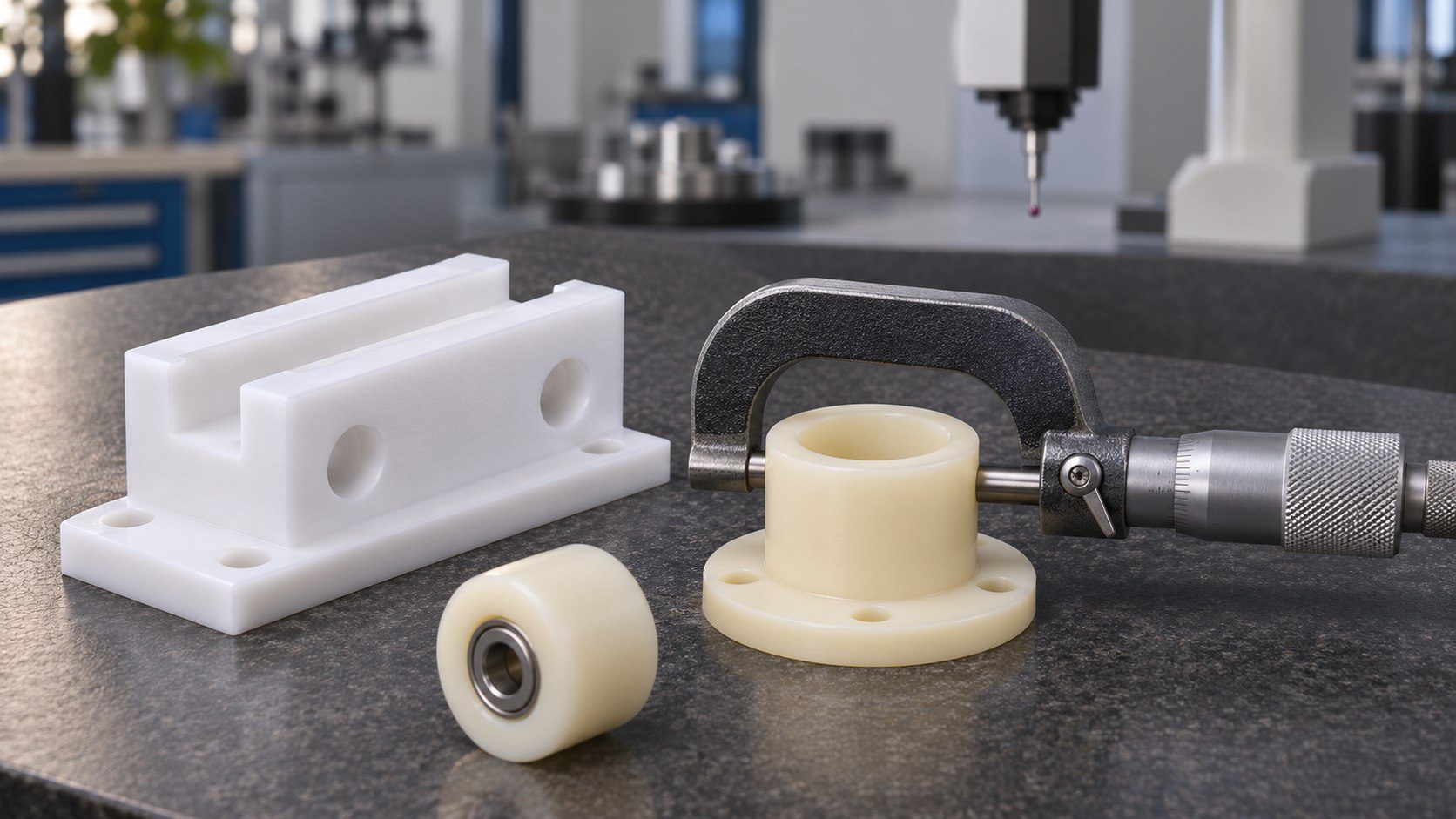
Three Precision-Part Selection Examples
The following are illustrative engineering scenarios, not customer case studies or guaranteed material approvals.
A precision guide block exposed to changing humidity
A guide block controls the position of a small sliding mechanism. Its clearance is limited, and workshop humidity differs from the customer’s operating environment. Begin by evaluating POM because moisture stability is central to the function. Check operating temperature, contamination and sustained load as well. Confirm movement and sliding force on a representative assembly.
A replaceable bushing in washed equipment
The bushing contacts a steel shaft and sees repeated wetting followed by drying. Review POM and suitable nylon bearing grades against the actual cleaning liquid, temperature and contact duration. For nylon, define conditioning and installed clearance explicitly. Validate starting torque and wear after exposure; a smooth-running dry sample alone does not settle the choice.
A loaded conveyor roller with impact events
A relatively large roller carries load and experiences occasional shocks. A suitable cast nylon or modified nylon grade may deserve evaluation alongside POM. Examine contact stress, deformation, bearing arrangement and duty cycle. If a selected nylon grade performs well, allow for environmental movement rather than imposing close tolerances on every nonfunctional surface.
Control Machining, Conditioning and Inspection Together
Sharp tooling, appropriate support and controlled cutting heat help both materials. Thin sections can deflect under clamping, and material removal can reveal internal stress. Plan the machining route around the geometry rather than expecting the material name alone to guarantee accuracy.
For a critical nylon component, agree whether stock or parts need conditioning before final machining or acceptance. Conditioning means establishing a defined moisture state; it is not simply leaving a part overnight. Ask the supplier how the state will be achieved and verified for the relevant section thickness.
Record inspection temperature, moisture condition, support and time after machining where these affect acceptance. Packaging and transport should be consistent with the agreed delivery condition. If service humidity varies, conditioning at one state does not remove the need to evaluate the full operating range.
What to Include in a POM vs Nylon RFQ
Give suppliers enough information to compare the same functional requirement:
- Exact material grade, color, stock form and approved alternatives.
- Critical dimensions, mating-part details and acceptable operating clearance.
- Temperature range, humidity, water contact and cleaning chemicals.
- Load, speed, lubrication, impact events and required service life.
- Conditioning, delivery state and inspection requirements.
- Quantity, traceability and any application-specific compliance documentation.
For demanding fits or wear duties, compare representative parts after realistic exposure and cycling. Measure the characteristics that determine success, such as alignment, torque, clearance or wear, rather than relying only on the initial dimensional report.
Frequently Asked Questions
Is POM always more accurate than nylon?
No. POM often simplifies moisture-related dimensional control, but geometry, temperature, grade and manufacturing still matter. Accuracy should be defined under the conditions relevant to assembly and service.
Does nylon need to be rejected for every wet application?
No. Suitable grades can work when the design accounts for moisture and the actual operating conditions. Tight clearances and repeated wet-dry cycling make validation especially important.
Can either material handle hot cleaning chemicals?
Check compatibility for the exact chemical, concentration, temperature and exposure duration. Neither a broad polymer name nor low moisture absorption proves suitability for hot-water or chemical cleaning.
Choose Around the Finished Part
For POM vs nylon, connect moisture behavior to the required fit, then evaluate load and wear under realistic conditions. Send Easiahome your drawing, material options, quantity and service environment so the grade, machining route and inspection plan can be reviewed together.