Choosing a CNC machining supplier in China is a decision about manufacturing risk, not simply a comparison of hourly rates. Before you send a drawing or place a production order, you need to know whether a supplier understands the part, can verify the critical features, and will explain what the quotation includes.
A polished equipment list is a starting point. A useful engineering response goes further: it identifies uncertain requirements, proposes a practical manufacturing route, and separates confirmed capability from assumptions that still need your approval.
This guide gives purchasing managers, mechanical engineers and OEM sourcing teams ten checks for evaluating a machining partner. Use it to build a shortlist, compare responses and decide when a supplier has earned the next step: a controlled drawing review and an initial sample order.
Discuss your drawing requirements with EASIAHOME. Start with your material, quantity and application. If the design is confidential, agree on the information-sharing process before sending detailed files.
What should a buyer look for in a CNC machining supplier in China?
Look for a supplier that connects your drawing requirements to a credible process and inspection plan. The strongest evidence is specific to your component: how it will be held, which dimensions drive the setup, what happens after heat treatment or coating, and how conformity will be documented.
There is no universal “best factory” for every part. A shop suited to simple production shafts may be a poor fit for a thin-walled housing with several related bores. A capable prototype shop may need a different process to maintain consistency across repeat orders.
Compare suppliers against the same specification, drawing revision and order quantities. Otherwise, a lower price may reflect a different interpretation rather than a more efficient process.
How buyers narrow their supplier search
When a buyer has an actual component to source, the search usually becomes more specific than “machining factory.” A useful search combines the process, material, component or sourcing requirement. The following are illustrative search phrases, not measured keyword-volume data.
| Buyer need | Example search | What the article or supplier page should answer |
|---|---|---|
| Shortlist a manufacturing partner | CNC machining supplier in China for custom parts | Process fit, drawing review and supplier verification |
| Source a particular material | 316 stainless steel CNC machining supplier | Material condition, machining challenges and inspection |
| Make a complex component | 5 axis CNC machining aluminum housing supplier | Tool access, workholding and whether five axes are needed |
| Start with a small order | low volume CNC machining prototype to production | Setup costs, sample approval and repeatability |
| Verify critical features | precision machined parts supplier inspection report | Measurement methods, reporting and acceptance criteria |
| Request a usable price | custom CNC machined parts quote from drawings | Required files, quantities, exclusions and lead-time assumptions |
A supplier page becomes worth an inquiry when it answers these questions with clear boundaries. Unsupported claims such as “any material,” “any tolerance” or “guaranteed lowest price” do not help an engineer release a purchase order.
1. Confirm that the supplier understands the component
Send a brief description of what the part does, together with the information you are comfortable sharing at the shortlist stage. Explain which surfaces locate the part, which bores guide movement, and which features affect sealing or assembly.
A good CNC machining supplier in China should ask focused questions when the specification is incomplete. For example: Does the bore size apply before or after coating? Is a sharp internal corner essential? Which drawing revision controls when a model and PDF disagree?
These questions are useful because they expose uncertainty before it becomes scrap. A supplier who immediately accepts every requirement without checking interfaces may be overlooking the same details that cause assembly failures later.
Evidence to request: a written list of drawing questions and proposed assumptions, with each issue linked to a feature or drawing note.
2. Match the manufacturing route to the geometry and quantity
Machine count alone does not establish process suitability. Ask how the part would move through production, including workholding, secondary operations and outside processing.
- Turning: often appropriate for components dominated by rotational features, such as shafts, sleeves and bushings.
- Milling: commonly used for prismatic parts, pockets, mounting faces and hole patterns.
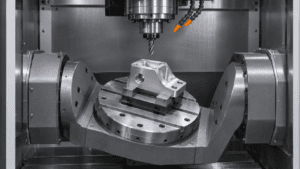
- Five-axis machining: may improve access or reduce repositioning on suitable geometry, but it is not automatically the cheapest route.
- Cast blank plus machining: may be worth evaluating for repeat production when the geometry, material requirements and tooling economics support it.
For a prototype, machining from stock may avoid tooling expenditure. For a recurring order, a near-net-shape blank may reduce material removal. Neither choice is universally better; compare the complete route, including tooling, qualification, yield and finishing.
Ask which operations are performed at the manufacturing site and which are subcontracted. Outsourcing a specialist process is not inherently a problem. Unclear responsibility for the specification and inspection is.
Explore EASIAHOME CNC machining services as a starting point, then request confirmation against your own part requirements.
3. Review tolerances in relation to function and measurement
A blanket claim of very tight machining accuracy is not enough. Capability depends on geometry, material condition, tool access, workholding, temperature, process sequence and the method used to measure the result.
Separate critical characteristics from general dimensions. A bearing seat, sealing face or datum-related hole pattern may need close control, while an external clearance surface may not. Applying the tightest available tolerance everywhere can add machining and inspection costs without improving the assembly.
Specify the drawing standard and applicable revision. ASME identifies Y14.5 as a framework for the language of geometric dimensioning and tolerancing; the standard specified by your design authority should govern interpretation. A supplier should not silently substitute a different convention.
Ask: “Which characteristics present the greatest manufacturing risk, and what inspection method will verify each one?” For a thin-walled part, also ask whether the agreed measurement condition is clamped or free state.
Any proposed tolerance relaxation needs buyer engineering approval. A lower price based on an unapproved deviation is not a compliant quotation.
4. Specify material grade, condition and traceability
“Aluminum” and “stainless steel” are incomplete purchasing specifications. State the alloy or grade, governing material specification where needed, and the required condition or heat treatment.
Two materials with similar names may behave differently during machining or in service. The supplier should confirm what stock form is being quoted and identify any proposed substitution separately.
For a CNC machining supplier in China, material traceability should be discussed before purchase if it is part of your acceptance requirements. Agree which records are required, how they relate to the supplied lot, and whether identification must remain through secondary processing.
A material certificate, a certificate of conformity and a dimensional inspection report answer different questions. Do not assume that one document replaces the others. If independent verification is required, define its scope and cost in advance.
Evidence to request: a redacted example of the proposed material documentation and an explanation of how the lot identity is retained.
5. Evaluate the inspection plan rather than the equipment photograph
A photograph of a coordinate measuring machine does not show how your component will be accepted. Inspection needs a defined reference, a suitable method and a record that can be traced back to the part revision and lot.
| Characteristic | Question for the supplier |
|---|---|
| Hole size and fit | Which gauge or measurement method is appropriate for this tolerance? |
| Position relative to datums | How will the part be aligned and the datum scheme evaluated? |
| Threads | What thread specification and verification method apply? |
| Surface texture | Where, in what direction and at which process stage will it be checked? |
| Coated or heat-treated features | Will final acceptance be assessed after the specified processing? |
| Lot release | Which features are checked on every part, and which use an agreed sampling plan? |
Do not assume that a full report means every feature was inspected on every unit. Clarify the number of parts, characteristic coverage and reporting format. Agree any first-article, customer-specific or production approval requirements before the order is placed.
For an initial purchase, a report tied to a ballooned drawing can make review more straightforward. Check that units, limits and actual results are clearly distinguished, and agree how nonconforming results will be reported.
6. Compare quotations on the same commercial and technical basis
A machining quotation should identify more than a unit price. Ask every candidate to price the same drawing revision, quantities, material and finish so that differences are visible.
Request separate lines for one-time costs and recurring costs. Depending on the project, these may include fixtures, programming, tooling, samples, production parts, special inspection, outside processing and packaging.
Confirm currency, quotation validity, payment milestones, delivery terms and the treatment of freight, duties and taxes. A delivery term should include its named place and the agreed rules edition where applicable.
A useful comparison considers total procurement cost: purchase price, tooling, qualification, logistics and the risk of unusable parts. The lowest unit price is not a saving if the batch cannot be assembled.
Watch for exclusions: unclear deburring, unspecified cosmetic criteria, inspection charged later, or a quotation that omits the material condition on the drawing. Ask for clarification before treating it as a firm comparison.
7. Separate prototype approval from production readiness
A sample proves something about the sample and its manufacturing route. It does not automatically prove repeatable production capacity.
Ask whether the sample and production batch will use the same material, setup concept, tooling and finishing route. If a production fixture or different blank will be introduced later, agree how the change will be validated.
Define what sample approval means. You may need dimensional acceptance, assembly testing, appearance approval or functional verification by your own team. Passing one category does not imply acceptance of the others.
Keep an approved drawing revision, inspection plan and any agreed appearance reference together. This creates a clearer baseline for the next order and makes it easier to identify an unauthorized change.
Practical approach: resolve feasibility questions, approve an initial sample, then release the next stage under an agreed control plan. The exact sequence should match your project risk.
8. Check whether the delivery schedule covers the entire route
“Two weeks” is not a complete schedule unless both parties understand the starting point and what happens before shipment. A lead time may start after drawing approval, deposit receipt, material arrival or sample acceptance.
Ask the supplier to identify material procurement, programming, machining, outside processing, inspection, packing and dispatch. Separate production lead time from transit time.
If there is a fixed assembly date, state the required arrival date and destination. Ask which milestones can be confirmed now and which depend on unresolved technical issues. A credible response explains dependencies rather than promising a date without reviewing the part.
For repeat orders, discuss forecast quantities and actual release quantities separately. A forecast helps planning but should not be confused with a committed purchase or reserved capacity.
9. Agree confidentiality and engineering change control
Before sharing proprietary geometry, discuss the NDA and permitted use of project files. Confirm which company receives the information and whether subcontractors need access.
A signed NDA is part of a process, not a substitute for deciding what information should be shared. Start with only what is needed for the current stage, and use an agreed transfer method for sensitive design files.
Change control matters just as much. Identify the drawing number and revision in the quotation and purchase order. Require written approval for material substitutions, tolerance deviations or changes affecting fit, function and inspection.
If a drawing changes after the order, ask for its effect on work already completed, stock, fixtures, price and delivery. A controlled discussion is better than assuming the new file automatically replaces every earlier instruction.
10. Test the quality of the technical response
The first exchange with a CNC machining supplier in China is a useful test of how the project may be managed. Look for an organized response that distinguishes confirmed requirements, open questions and proposed alternatives.
A helpful supplier does not need to agree with every detail. It should explain why a feature is difficult, what information is missing, and which options preserve the intended function. It should also say when a capability or deadline cannot yet be confirmed.
For example, a deep narrow pocket may require a long tool with limited rigidity. A useful response could propose a larger corner radius or a geometry change for your approval, while also explaining the cost of retaining the original design. “No problem” provides less engineering value.
Before awarding production, verify the legal entity, manufacturing location, applicable certificates and responsibility for subcontracted work. If a certification is essential, check the certificate scope and validity instead of relying on a logo.
A practical supplier comparison worksheet
Use this worksheet after the initial drawing review. An unanswered question is a follow-up item, not automatic evidence of failure.
| Decision area | Evidence to record | Release question |
|---|---|---|
| Process fit | Proposed operations and workholding approach | Is the route appropriate for the geometry and quantity? |
| Drawing review | Questions, assumptions and approved deviations | Are all critical ambiguities resolved? |
| Material | Grade, condition and required records | Is the quoted material exactly what we specified? |
| Inspection | Methods, sample sizes and report example | Can we verify acceptance from the agreed evidence? |
| Commercial scope | Unit costs, one-time costs and exclusions | Are competing quotations comparable? |
| Delivery | Milestones, starting conditions and transit | Does the schedule support our project? |
| Control | Revision baseline and change approval process | Will future changes remain visible? |
What to send for an initial drawing review
You do not need to finish an enormous supplier questionnaire before making contact. Send a concise project brief that allows a manufacturing team to decide whether further review is worthwhile.
- Part name, drawing number and current revision.
- Dimensioned 2D drawing and a 3D model, if available.
- Material grade, condition and required surface treatment.
- Prototype quantity, order quantity and any forecast, clearly separated.
- Critical tolerances, mating features and inspection deliverables.
- Required arrival date, destination and any packaging constraints.
- Open design questions and whether alternatives may be proposed.
- Confidentiality requirements before detailed files are exchanged.
Where possible, include a STEP model for geometry and a PDF drawing for requirements. Agree which document controls if there is a conflict. A model alone may not communicate tolerances, surface texture, threads or acceptance conditions.
For a more detailed file-preparation guide, see how to prepare CAD files and drawings for a CNC machining quote.
Start a machining project discussion with EASIAHOME
EASIAHOME presents CNC machining and investment casting among its manufacturing services. For your own component, the right starting point is a review of the drawing, material, quantity and inspection expectations—not a generic promise of a tolerance or delivery date.
If you are evaluating a CNC machining supplier in China, contact EASIAHOME to discuss your project. Tell us whether you need a prototype, a repeat production part or an evaluation of alternative manufacturing routes.
Suggested inquiry subject: RFQ – [Part Number / Revision] – [Material] – [Quantity]
In your message, ask for feasibility comments, open technical questions, the proposed quotation scope and lead-time assumptions. If an NDA is required, raise it before attaching confidential drawings. Use the contact page for the initial discussion; confirm the appropriate file-transfer method with the team.
The goal of a first inquiry is a clear next step: determine whether the part fits the supplier’s capabilities and what must be resolved before a usable quotation or sample plan can be prepared.
Frequently asked questions
Can I request a machining quote without a finished drawing?
Yes, you can request an initial discussion using a model, sample information or a project brief. Label the missing requirements. An early estimate should identify its assumptions, and a controlled specification should be agreed before production is released.
Does every precision part need five-axis machining?
No. The right route depends on geometry, tool access, tolerances, workholding and quantity. Ask the supplier to explain why the proposed process is appropriate rather than selecting equipment by axis count alone.
How do I verify a CNC machining supplier in China?
Verify the legal entity and manufacturing location, review relevant evidence, discuss the inspection plan and assess a controlled sample where appropriate. Confirm which processes are subcontracted. If your project requires certification or a specific approval process, verify that requirement separately.
Should I choose the lowest machining quotation?
Compare prices only after aligning the technical and commercial scope. Material condition, finishing, inspection, fixtures and logistics can all change the total cost. Resolve omissions before comparing the final offer.
What tolerance can a supplier guarantee?
There is no meaningful universal answer for all parts. Ask for confirmation against your drawing and critical features, together with the proposed inspection method. Any capability statement should be tied to defined geometry and manufacturing conditions.
What makes an inquiry easier to evaluate?
A consistent drawing revision, material specification, order quantity, finish, critical features and required delivery date. A concise explanation of how the part functions helps the supplier identify questions that the geometry alone may not reveal.
Technical reference
For drawing interpretation, consult the applicable standard specified by your design authority. ASME Y14 standards include resources relating to dimensioning and tolerancing. This article is a procurement checklist; project-specific drawings and agreed acceptance requirements govern the order.