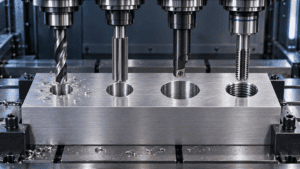
CNC machining undercuts are small design details that can have a large effect on price, lead time, and manufacturability. A normal end mill can cut open pockets, slots, holes, and profiles from a clear approach direction. An undercut is different because part of the feature is hidden behind a wall, shoulder, lip, or overhang. The cutter must reach behind that obstruction without the tool body or holder colliding with the part.
Undercuts are not automatically bad. They are often required for O-ring grooves, retaining rings, thread reliefs, snap fits, dovetail slides, T-slots, sealing details, and assembly clearance. The problem begins when the feature is designed without considering available tools, tool access, tolerance, or inspection. In that case, a simple-looking CAD detail may require special cutters, extra setups, 5-axis machining, EDM, or a design review before it can be quoted accurately.
This guide explains the main types of CNC machining undercuts, the tools used to machine them, practical size rules, cost drivers, and the quote information your supplier needs.
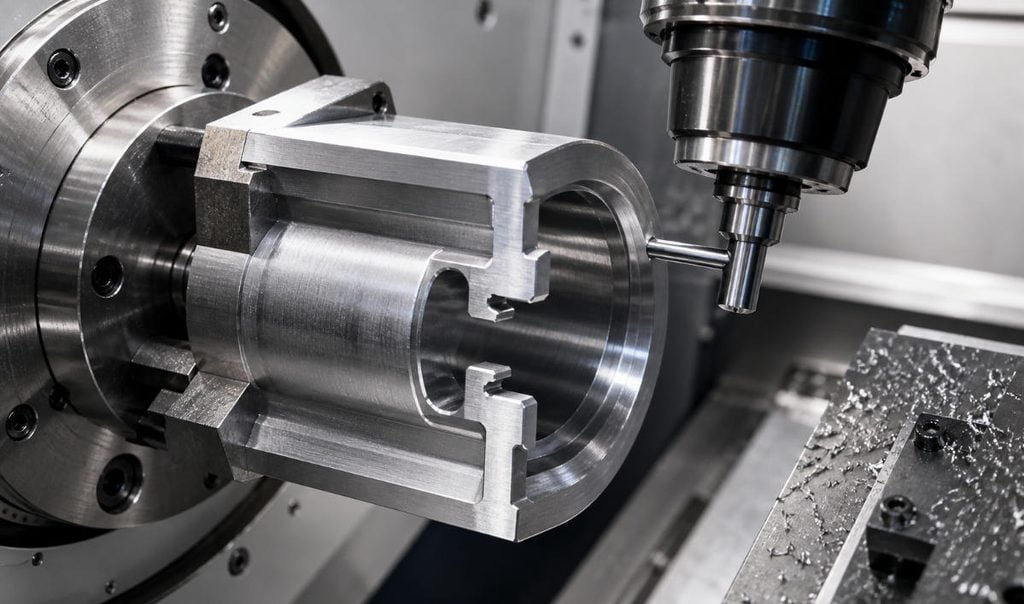
What Is an Undercut in CNC Machining?
An undercut is a recessed feature that cannot be reached by a standard straight tool path. In milling, the limitation is usually tool access. The cutting edge may need to machine the side or back of a feature while the shank passes through a narrow opening. In turning, undercuts often appear as relief grooves near shoulders, threads, sealing areas, or retaining features.
Typical examples include an internal groove inside a bore, a T-slot under a surface, a dovetail profile, a reverse radius, or a relief behind a threaded shoulder. For quoting, the most important question is not only whether the geometry can be machined, but whether it can be machined reliably, inspected clearly, and repeated at the required quantity.
Why Undercuts Matter for DFM and Quoting
Undercuts often look minor in CAD, but they can change the manufacturing route. A shallow open groove may be simple if a standard cutter fits. A similar groove deep inside a pocket may need a long-reach tool, slow feeds, special fixturing, or a different process. That is why undercuts should be reviewed during Design for CNC Machining DFM, not after the drawing is released.
Before requesting a quote, decide whether the undercut is functional or only a leftover modeling detail. Functional undercuts should be documented. Nonfunctional undercuts should usually be removed, opened up, or simplified.
Common Types of CNC Machining Undercuts
| Undercut type | Typical use | Machining note |
|---|---|---|
| T-slot undercut | Fixture slots, clamp features, sliding nuts | Usually cut with a T-slot cutter after a straight entry slot is opened. |
| Dovetail undercut | Slides, locating rails, locking surfaces | Best when the angle matches a standard dovetail cutter, often 45 or 60 degrees. |
| Internal groove | O-rings, retaining rings, seals, snap rings | May be milled with a slotting cutter or turned with an internal grooving tool. |
| Lollipop undercut | Reverse radii, blended reliefs, complex 3D surfaces | Useful for curved geometry but sensitive to deflection and collision risk. |
| Relief undercut | Thread relief, shoulder clearance, assembly clearance | Often economical if the purpose and tolerance are clear. |
| Hidden backside feature | Hooks, clips, lightweighting pockets, hidden channels | May require part flipping, angled access, 4-axis, or 5-axis machining. |
T-slots and dovetails are usually more predictable because standard cutter families are available. Hidden pockets and reverse radii are less predictable because the tool must reach around surrounding geometry while maintaining stiffness and avoiding collision.
Tools Used to Machine Undercuts
| Tool or process | Best for | Design implication |
|---|---|---|
| T-slot cutter | T-shaped grooves and recessed shoulders | Needs a clear entry slot and side clearance. |
| Dovetail cutter | Angled locking profiles and slide features | Nonstandard angles can increase tooling cost. |
| Lollipop cutter | Reverse radii and spherical reliefs | Requires careful toolpath simulation and stable cutting conditions. |
| Keyseat or slotting cutter | Side grooves and retaining ring features | Works best when groove width matches standard cutter sizes. |
| Internal grooving tool | Turned grooves inside bores | Needs enough bore diameter, reach, and chip evacuation room. |
| Custom form tool | Special profiles or repeat production | Adds tooling cost but can reduce cycle time at volume. |
| 4-axis or 5-axis machining | Blocked or angled access features | Improves access but adds programming, setup, and inspection cost. |
The most economical option is not always the most advanced machine. A well-designed 3-axis feature using a standard T-slot cutter may cost less than a complex 5-axis tool path. The right method depends on geometry, material, tolerance, finish, and quantity.
Standard Sizes and Practical Design Rules
There is no universal standard size chart for every undercut, because each supplier has different tooling. However, the following rules make parts easier to quote and manufacture.
- Use standard cutter widths. T-slot and slotting cutters are commonly available across many metric sizes, but arbitrary groove widths may require purchased or custom-ground tooling.
- Keep depth reasonable. As a starting point, keep undercut depth near or below about two times the cutter width when possible. Deep, narrow features increase deflection and breakage risk.
- Add tool clearance. The cutter body, shank, and holder need space. Tight surrounding walls can make a machinable profile impossible in practice.
- Match common dovetail angles. 45 degree and 60 degree dovetail cutters are common. Special angles should be justified by function.
- Use larger internal radii. Bigger radii allow stronger tools, better surface finish, and shorter cycle time.
- Do not over-tolerance clearance features. If the undercut only prevents interference, avoid precision callouts that do not affect function.
- State the purpose on the drawing. Notes such as “clearance relief only” or “O-ring groove, sealing surface critical” help the supplier quote correctly.
These are quoting guidelines, not fixed limits. For critical parts, the supplier should review the STEP file, cutter access, and drawing before production.
How Undercuts Affect CNC Machining Cost
An undercut increases cost when it adds special tooling, extra setups, slower machining, or difficult inspection. The part may still be manufacturable, but the process becomes less direct.
- Special tooling: Lollipop cutters, long-reach slotting tools, and custom form tools may add cost and lead time.
- Tool reach: Long or thin tools are more likely to vibrate, leaving chatter, tool marks, or inconsistent dimensions.
- Extra setups: If the part must be flipped or refixtured, setup time and alignment risk increase.
- Machine selection: 4-axis, 5-axis, EDM, or custom fixturing may be required for hidden geometry.
- Material: Stainless steel, titanium, hardened steel, and heat-resistant alloys make undercuts harder than aluminum or brass.
- Surface finish: A hidden clearance groove is easier than a polished sealing groove or cosmetic undercut.
- Inspection: Internal grooves may need special gauges, CMM planning, or functional testing.
If budget is important, ask whether a small geometry change can keep the same function while using a standard tool. For more cost guidance, see our article on reducing complex CNC machining difficulty and costs.
How to Reduce Undercut Cost
The best undercut is the one that performs its function with stable tooling and clear inspection. Use these design changes before releasing the part for quote:
- Open the feature if the surrounding wall is not functional.
- Split the part into two pieces if a hidden feature makes machining too difficult.
- Adjust width, radius, or angle to match standard cutter geometry.
- Increase access clearance around the cutter and holder.
- Move the feature to a direction that can be machined in a normal setup.
- Relax tolerances on noncritical surfaces.
- Define a practical inspection method before production.
For precision assemblies, review undercuts together with CNC machining tolerances. A groove that is easy at +/-0.10 mm can become expensive at +/-0.02 mm, especially when it is deep, internal, or hard to measure.
What to Send for a CNC Machining Undercut Quote
A clear quote package helps the engineering team choose the right process before pricing. Send both a 3D model and a 2D drawing. The model shows geometry, while the drawing explains function, tolerance, material, finish, and inspection needs.
| Quote item | Why it matters |
|---|---|
| STEP file | Shows access, collision risk, and machining sequence. |
| Technical drawing | Defines critical dimensions, tolerances, finish, material, and notes. |
| Undercut dimensions | Width, depth, radius, angle, bore diameter, and wall distance affect tooling. |
| Functional purpose | Clarifies whether the feature is for clearance, sealing, retention, sliding, or appearance. |
| Material and finish | Influence cutter choice, feeds, deburring, coating, and inspection. |
| Quantity | Determines whether standard tooling or custom tooling makes sense. |
| Inspection requirements | Prevents disputes about how hidden geometry should be verified. |
If you are unsure which dimensions to call out, describe how the feature works in the assembly. A note such as “internal groove retains O-ring; sealing diameter is critical” gives the machinist useful direction. You can also review our guide on preparing files for a CNC machining quote.
Can Undercuts Be Machined on a 3-Axis CNC Machine?
Yes, many undercuts can be machined on a 3-axis CNC mill if the cutter can enter the feature and has enough clearance. T-slots, side grooves, and relief cuts are common examples. If the feature is blocked by surrounding geometry, 4-axis or 5-axis machining may be more practical.
Are Undercuts Always Expensive?
No. A standard relief groove with open access may add little cost. Undercuts become expensive when they are deep, narrow, nonstandard, difficult to inspect, or located where the cutter cannot approach safely. Quantity also matters: custom tooling may not suit one prototype, but it can make sense for repeat production.
Final CNC Undercut Design Checklist
- Is the undercut required for function, assembly, sealing, or retention?
- Can the feature be opened, simplified, or moved?
- Does it match a standard T-slot, dovetail, slotting, or lollipop cutter?
- Is there enough clearance for the cutter body and holder?
- Are width, depth, radius, and angle clearly defined?
- Are tight tolerances limited to functional surfaces?
- Can the undercut be inspected with normal tools or gauges?
- Are material, finish, quantity, and inspection requirements included?
CNC machining undercuts are manageable when they are designed with manufacturing in mind. A small change to cutter access, groove width, radius, or tolerance can turn a difficult feature into a predictable machined detail. If your next project includes undercuts, send your STEP file and technical drawing to Easiahome’s CNC machining services team for manufacturability review and a practical quote.